Digital experience platform modernization is not a platform swap. It is the work of removing the constraints that stop an enterprise from delivering and scaling better digital experiences. Most enterprises reach a tipping point where their existing DXP can no longer keep up with new channels, the speed the business needs, or its governance obligations, and the instinct is to rip it out and replace it. That is often the wrong move. The right one is to decide, based on business and experience outcomes, whether to optimize, upgrade, replatform or replace, and then modernize incrementally. This guide sets out how we approach that decision and the roadmap that follows.
What Is Digital Experience Platform Modernization?
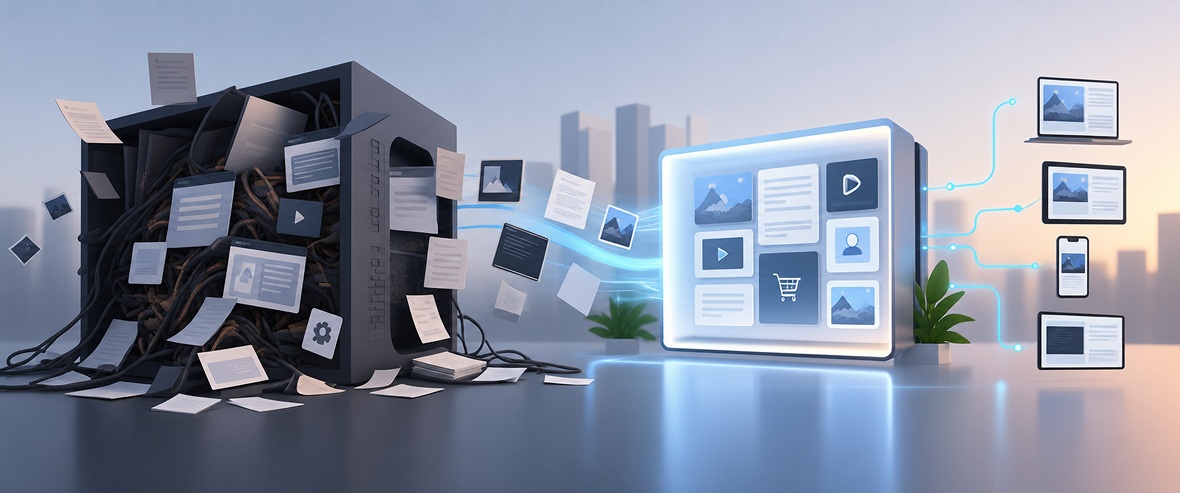
Digital experience platform modernization is the process of upgrading or re-architecting an enterprise’s DXP, often toward composable, cloud-native or headless models, to improve scalability, speed and omnichannel delivery.
The important thing modernization is not is a full re-platform. It can mean incremental upgrades to the current platform, a hybrid approach that adds modern capabilities alongside the existing system, or a deeper architecture change, depending on what the business actually needs. Framing it only as a move to headless or composable architecture misses the point, because the goal is the outcome, not the architecture.
The shift is also increasingly shaped by how content is discovered, not just how it is presented. In its Q4 2025 Digital Experience Platforms Wave, Forrester describes the market moving from feature accumulation to orchestration, with agentic AI and AI-driven discovery reshaping what a modern experience platform has to do. Modernization now has to account for AI assistants and agents that consume content directly, not only human-facing user experience.
Signs Your Enterprise Is Outgrowing Its Current DXP
Outgrowing a DXP rarely announces itself. It shows up as friction that teams learn to work around until the cumulative cost becomes hard to ignore. The signs below are a self-diagnostic; an enterprise that recognizes several of them is likely past the point where its platform is helping more than it hinders.
- Slow time-to-market: launching a new campaign, page or experience takes weeks and depends on developers for changes a marketer should own.
- Inability to support new channels: the platform struggles to serve mobile apps, IoT screens, voice and AI assistants because it was built to publish web pages.
- Rising maintenance and licensing costs: more of the budget funds keeping the platform running than improving the experience.
- Content and data silos: separate instances per brand or region mean content is duplicated and there is no single source of truth.
- A frontend constrained by legacy templates: the experience is capped by what the platform’s templates allow, not by what the business wants to build.
None of these on its own forces a decision. Together they signal that the platform has become a constraint on the experience the enterprise wants to deliver, which is the point at which modernization moves from optional to overdue.
Why Digital Experience Platform Modernization Matters Now
Modernization has always mattered, but the cost of delay has risen sharply. The forces below have changed what a digital experience has to do, and each widens the gap between enterprises that modernize and those that wait.
The Rise of the Agentic Web and AI-Discoverable Content
Content is increasingly consumed by AI assistants and agents, not only by people browsing a site. That requires structured, API-accessible content a legacy DXP often cannot expose cleanly. An enterprise whose content is locked in page templates is becoming invisible to the systems that now mediate discovery.
Customer Expectations for Real-Time, Personalized Omnichannel Experiences
Customers expect consistent, personalized experiences across every channel, delivered in real time. Meeting that expectation depends on connected content and data, which siloed legacy platforms cannot provide. The experience gap is felt directly by the customer.
Competitive Pressure From Digitally Mature Peers
Competitors that have modernized ship experiences faster and adapt more quickly. That speed compounds over time into a market advantage. Falling behind on platform capability becomes falling behind on the business itself.
The Rising Cost and Risk of Delaying Modernization
Waiting is not free. Every quarter of delay adds integration debt, raises the eventual cost of the move and lengthens the gap with faster peers. Gartner analysts have also warned that autonomy and composability can outpace governance and operational readiness, so the enterprises that delay face a harder, riskier modernization when they finally act.
Taken together, these forces mean digital experience modernization is no longer a question of whether, but of when and how. The cost of waiting is the part competitor content tends to underplay, and it is the part leadership should weigh most carefully.
Case Study: From Legacy Monoliths to a Cloud-Native Platform
Core Components of a DXP Modernization Roadmap
Our approach treats modernization as a structured sequence rather than a single migration event, and as a business decision before a technology one. The six phases below take an enterprise from understanding its current estate to running a modern, well-governed experience platform, without disrupting the business along the way. Running underneath all six is a horizontal layer of AI and agentic acceleration, applied within every phase rather than as a stage of its own.
| Phase | Objective | Key activities |
|---|---|---|
| Assess | Understand the current estate and where it constrains the business | Audit architecture, content, integrations, data and experience gaps |
| Decide | Choose the right modernization path per property | Apply the optimize, upgrade, replatform or replace decision |
| Architect | Design the target experience architecture to fit the need | Choose traditional, headless, composable or hybrid; design content, data and integration model |
| Modernize | Execute incrementally, protecting business continuity | Pilot on a low-risk property, then phased, rolling migration |
| Validate | Confirm the target meets enterprise standards before scale | Test against quality, security, performance, accessibility, SEO and governance guardrails |
| Optimize | Sustain and improve the experience after go-live | Tune performance, cost, personalization and content operations continuously |
Read this as a phased journey, not a checklist to rush. The horizontal AI and agentic acceleration layer speeds work within each phase, from content analysis in Assess to code and test generation in Modernize, while human engineering, security and governance stay in control throughout.
The Decision: Optimize, Upgrade, Replatform or Replace
The heart of the Decide phase is choosing the right path, and this is where enterprises most often overreach. Not every constraint requires a replatform, and not every DXP needs replacing. The four paths below scale with the severity of the constraint, and most enterprise estates use more than one across their properties.
| Path | What it means | Best fit |
|---|---|---|
| Optimize | Improve the current platform without changing it | The platform still fits; the problem is configuration, performance or process |
| Upgrade | Move to a newer version or add modern capabilities | The platform is sound but a version or module behind |
| Replatform | Re-architect onto a modern model while reusing what works | The architecture is the constraint, but not everything needs rebuilding |
| Replace | Move to a different platform entirely | The current platform cannot meet the requirements at any reasonable cost |
Our guidance is to choose the least disruptive path that removes the constraint, because reaching for replace when optimize would do is the most common way DXP modernization budgets overrun. The decision should rest on business and experience outcomes, not on the appeal of a new architecture.
How to Modernize a Digital Experience Platform: Step-by-Step
Once the path is chosen, execution follows a repeatable sequence. Each step below is deliberately incremental, so the enterprise learns and de-risks as it goes rather than betting the outcome on a single cutover.
Step 1: Audit Current Architecture, Content and Integrations
Map the current platform, content, data and every integration it depends on. This inventory defines the scope and surfaces the hidden dependencies that derail migrations. What is not mapped cannot be modernized safely.
Step 2: Define the Target Architecture
Decide the target model, traditional, headless, composable or hybrid, based on the enterprise’s channel strategy and technical maturity. The choice should fit the need rather than follow a trend. Architecture is a means to the experience outcome, not the goal itself.
Step 3: Prioritize Channels and Use Cases for the First Release
Choose a focused first release that proves value quickly. A narrow, high-value slice builds confidence and surfaces problems early. Trying to move everything at once is how modernization stalls.
Step 4: Run a Pilot on a Low-Risk Property or Region
Validate the approach on a property the business can afford to test. The pilot proves the architecture, the migration process and the guardrails end to end. Scale only once the pilot holds up.
Step 5: Execute a Phased, Rolling Migration
Move properties in waves, keeping old and new running in parallel during the transition. Each wave validates before the next begins, and a rollback path stays ready throughout. This is what protects business continuity through the change.
Step 6: Establish Governance and Ongoing Optimization
Put governance, monitoring and an optimization cadence in place so the modern platform keeps delivering. Go-live is the start of the operating phase, not the end of the project. The takeaway across all six steps is that incremental beats big-bang every time.
Architecture Choices: Traditional, Headless, Composable or Hybrid
The target architecture should be chosen for enterprise fit, not because composable or headless is the current trend. Each model suits a different situation, and for many enterprises a hybrid is the pragmatic answer. The options below frame the choice.
- Traditional (coupled) DXP: content and presentation together, fast for standard web publishing but limited across channels.
- Headless: content delivered through APIs to any front end, strong for multichannel reach where the team can build and run front ends.
- Composable: best-of-breed components assembled into a stack, flexible but with real integration and governance overhead.
- Hybrid: modern API-first delivery added alongside a coupled core, a practical middle path that adds capability without a full rebuild.
The right model depends on channel breadth, in-house engineering capacity and governance needs, not on which architecture is fashionable. A vendor-agnostic assessment picks the fit, which is why we do not force headless or composable where a simpler model serves the outcome better.
Content, Data, Integrations and AI as One Connected Ecosystem
A modern experience platform is not just a CMS with a new frontend. It is a connected ecosystem where content, customer data, integrations and AI work together, and treating any one of them in isolation is how modernization underdelivers. The elements below are what that ecosystem has to connect.
Content becomes structured and API-accessible so it can serve every channel, including AI assistants, from one source. Customer data connects to the experience so personalization is real rather than cosmetic. Integrations with CRM, DAM, PIM and commerce systems make the platform part of the wider stack rather than an island. And AI is applied where it materially improves content operations, personalization, discovery and customer experience, not because it is expected. Forrester’s framing of the emerging agentic DXP, where AI coordinates content, data and workflows, is exactly this connected view, and it is the level at which modernization should be planned.
Enterprise Guardrails: Building Quality In, Not Bolting It On
Modernization is only a success if the result holds up in production, so the guardrails below are built into every phase rather than checked at the end. Validating them only at go-live is how enterprises discover a performance, accessibility or governance problem too late to fix cheaply.
- Quality engineering: automated testing across content, integrations and experience, with quality gates before each release.
- Security: data protection, access control and secure integrations designed in from the start.
- Performance: fast page delivery and healthy Core Web Vitals as a requirement, not an afterthought.
- Accessibility: experiences that meet accessibility standards for every user.
- SEO and discoverability: preserved rankings, clean redirects and content structured for both search and AI discovery.
- Governance: approval workflows, audit trails and content governance enforced in the platform.
Building these in as the modernization proceeds is what separates a platform that improves agility from one that trades experience quality for speed. Guardrails are a design input, not a launch-day inspection.
Also Read: Why Your Business Needs a Digital Experience Platform
Build vs Buy: In-House Modernization or Modernization Services
Every enterprise faces a choice between modernizing in-house and bringing in experience platform modernization services. The right answer depends on internal capacity, timeline and the complexity of the estate, and the comparison below frames it neutrally.
When In-House Modernization Makes Sense
In-house works when the enterprise has strong platform engineering capacity, experience with the target architecture and the bandwidth to run modernization alongside ongoing delivery. Where that depth exists, keeping the work internal preserves control and builds lasting capability.
When to Bring in Experience Platform Modernization Services
External help pays off when the estate is complex, the target architecture is unfamiliar or internal bandwidth is thin. A partner brings proven migration experience and speed that would take an internal team much longer to develop. The point is to fill a genuine gap, not to outsource ownership.
What Experience Platform Modernization Consulting Typically Includes
A good engagement covers the current-state audit, target architecture design, vendor-neutral platform selection, migration execution and change management. Experience platform modernization consulting is most valuable early, shaping the decision and the roadmap, rather than only executing a plan someone else has already fixed.
The honest framing is that build and buy are not opposites. Many enterprises combine internal ownership with outside expertise where it fills a gap, which keeps control in-house while accelerating the parts that would otherwise stall.
Common Risks and Challenges in DXP Modernization
Modernization is worth doing and not without real risk. Naming the common challenges upfront leads to a more realistic plan, and each of the risks below has derailed otherwise sound programs.
- Underestimating content migration complexity, especially across many properties, brands and languages.
- Integration debt with CRM, DAM, PIM and commerce systems that surfaces only mid-migration.
- Organizational resistance and skill gaps, since a modern platform needs new ways of working.
- Scope creep that quietly turns a targeted modernization into a full re-platform.
Each risk is manageable when anticipated and designed around. Ignoring them is what turns a phased, low-risk modernization into the big-bang project it was meant to avoid.
How to Choose an Experience Platform Modernization Consulting Partner
Choosing a partner is a decision worth structuring like a procurement exercise rather than a pitch. The vendor-neutral checklist below is one an enterprise can take directly into a selection conversation.
- Demonstrated experience with composable and headless architectures, not just one vendor’s stack.
- Enterprise-scale migration references that match the size and complexity of your estate.
- A clear approach to change management and training, since adoption decides whether modernization sticks.
- A defined post-launch optimization and support model, because modernization continues past go-live.
- Alignment with your governance and compliance needs, confirmed before the engagement begins.
A partner who meets these criteria is equipped for enterprise modernization rather than a standard build. The strongest partners are platform and vendor agnostic, recommending the architecture that fits the enterprise rather than the one they prefer to sell.
Measuring Success After DXP Modernization
Modernization succeeds or fails against experience and business outcomes, not against whether a migration completed. Success is defined upfront in measurable terms and tracked after launch, and the measures below close the loop back to why the enterprise modernized in the first place.
- Time-to-publish and development velocity: how much faster the team ships new experiences.
- Omnichannel reach and content reuse rate: how effectively one content source serves every channel.
- Page performance and Core Web Vitals: measurable improvements in speed and experience quality.
- Total cost of ownership post-migration: the full running cost, not just the migration cost.
- AI and assistant discoverability: how well content is cited and surfaced by AI-driven discovery.
Defining success this way keeps modernization honest. A migration that completes but improves none of these has not delivered what it set out to, which is why we measure modernization through speed, experience, scalability, adoption and TCO rather than through the migration itself.
Moving Forward
DXP modernization is not about replacing the CMS. It is about removing the constraints that prevent the enterprise from delivering and scaling better digital experiences, and doing it as a phased journey rather than a single migration event. The right roadmap depends on channel strategy, technical maturity and internal capacity, which is why the decision, optimize, upgrade, replatform or replace, comes before any architecture choice. An enterprise that assesses its estate honestly, decides on outcomes, modernizes incrementally and builds guardrails in throughout can move forward with confidence rather than risk. Assess your current DXP maturity, or speak with an experience platform modernization specialist, before scoping your next phase.
FAQs
What is digital experience platform modernization?
It is the process of upgrading or re-architecting an enterprise’s DXP, often toward composable, cloud-native or headless models, to improve scalability, speed and omnichannel delivery. It can mean incremental upgrades, a hybrid approach or a deeper architecture change, not necessarily a full replatform.
How do I know if my enterprise needs DXP modernization?
Common signs include slow time-to-market, an inability to support new channels such as apps and AI assistants, rising maintenance and licensing costs, content and data silos across brands or regions, and a frontend constrained by legacy templates. Several of these together usually signal the platform has become a constraint.
What is the difference between DXP modernization and a full re-platform?
A full re-platform replaces the entire platform in one move. Modernization is broader and usually incremental: it can mean optimizing the current platform, upgrading it, replatforming selectively or replacing it, chosen per property based on the constraint and the business outcome.
How long does a DXP modernization roadmap typically take?
It depends on the size of the estate, the number of properties and integrations, and the path chosen. A phased, incremental approach spreads the work over time and reduces risk rather than concentrating it in a single large project, so timelines vary widely by scope.
What do experience platform modernization services include?
They typically cover a current-state audit, target architecture design, vendor-neutral platform selection, migration execution and change management, along with a post-launch optimization and support model. The most value comes early, in shaping the decision and roadmap.
Should I modernize in-house or hire a consulting partner?
In-house suits enterprises with strong platform engineering capacity and experience with the target architecture. A partner helps when the estate is complex, the architecture is unfamiliar or internal bandwidth is thin. Many enterprises combine both, keeping ownership internal while filling gaps externally.
What are the biggest risks in DXP modernization?
The main risks are underestimating content migration complexity, integration debt with CRM, DAM, PIM and commerce systems, organizational resistance and skill gaps, and scope creep that turns a targeted modernization into a full re-platform. Each is manageable when planned for upfront.
How much does DXP modernization cost?
Cost varies with the path chosen, the size of the estate and the number of integrations. Optimizing or upgrading costs far less than replatforming or replacing, which is why choosing the least disruptive path that removes the constraint matters. Total cost of ownership, not just the migration cost, is the honest figure to plan against.
Is a composable or headless architecture required for modernization?
No. Composable and headless suit enterprises with broad channel needs and the capacity to run them, but a traditional or hybrid model is often the better fit. The architecture should be chosen for enterprise fit and business outcomes, not because a particular model is trending.