Cloud migration rarely fails because enterprises lack ambition. It fails when teams underestimate dependencies, application complexity, costs, and operational risk. As cloud investment grows, these blind spots become more expensive.
Statista reports cloud infrastructure service revenues reached $419 billion in 2025. That figure was nearly nine times the 2017 level.
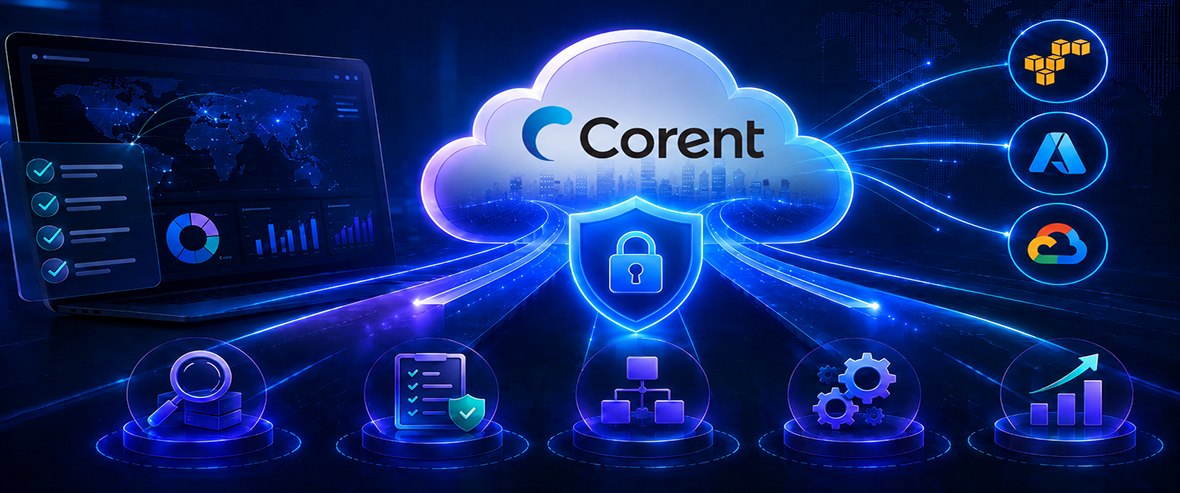
Legacy estates remain difficult when discovery, assessment, planning, and execution depend on disconnected tools. Corent MaaS addresses this gap through AI-assisted discovery, assessment, dependency mapping, planning, and migration execution.
Its AI capabilities can surface hidden relationships, compare target options, and support workload-level migration decisions. Teams can evaluate AWS, Azure, and Google Cloud within one structured migration workflow.
The following sections explain how Corent MaaS works, where AI adds value, and what enterprises should validate.
Key Takeaways
Here are the key takeaways from this guide to Corent MaaS and automated enterprise cloud migration:
- Understand how Corent MaaS delivers Migration as a Service through a unified cloud migration platform.
- Explore how automation improves discovery, assessment, planning, and execution across complex IT environments.
- Learn how AI strengthens cloud readiness, risk analysis, dependency mapping, and target-state comparisons.
- Discover how MaaS builds migration roadmaps around workload priorities, dependencies, and business objectives.
- Review support for AWS, Azure, GCP, and multi-cloud migration scenarios.
- See how automation streamlines landing zones, infrastructure provisioning, migration waves, and legacy application migration.
- Learn how cost analysis and AI-assisted planning reduce uncertainty, downtime, and migration risk.
What Is Corent MaaS and How Does Migration as a Service Work?
Corent MaaS is an AI-powered cloud migration platform for assessment, planning, migration, and modernization. It supports application migration across AWS, Azure, Google Cloud, and cloud-based VMware environments.
Corent also positions MaaS for datacenter-to-cloud and cloud-to-cloud migration.
Migration as a Service combines software automation, migration methods, and delivery workflows into a single operating model. This differs from tools focused only on discovery, replication, costing, or project tracking.
Corent MaaS connects these activities through shared inventory data, assessment models, and migration plans. Its AI layer adds decision support across that lifecycle.
It can analyze utilization, dependencies, compatibility, costs, and migration patterns at portfolio scale. GenAI insights can help teams interpret findings, compare scenarios, and organize migration decisions faster.
In practice, its documented capabilities form five connected stages:
- Discover: MaaS inventories servers, operating systems, databases, storage, software processes, utilization, and network relationships.
- Assess: AI-assisted analysis evaluates readiness, dependencies, compatibility, rightsizing, licensing, risks, and projected costs.
- Plan: Teams create move groups, migration waves, target architectures, and workload-specific migration strategies.
- Prepare: The platform creates landing zones and generates Terraform, ARM, or CloudFormation infrastructure templates.
- Migrate: MaaS supports application and virtual-machine migration using methods selected for each workload.
AWS Prescriptive Guidance lists agentless and agent-based discovery among Corent MaaS capabilities. It also lists server-level and software-process dependency mapping.
These capabilities support evidence-based assessments instead of inventory assumptions. AI can then help prioritize findings across large application portfolios.
However, architects must validate recommendations against business criticality, compliance, and operational constraints. Consider a three-tier order-management application spanning web servers, application services, and a shared database. Dependency mapping can identify components requiring coordinated migration.
AI-assisted planning can group them together and recommend a suitable migration wave. Architects can then validate downtime, rollback, security, and performance requirements. Lifecycle continuity remains a key distinction of Corent MaaS. Discovery evidence feeds assessment, planning, provisioning, and execution.
Microsoft Marketplace also lists GenAI insights, wave planning, landing-zone creation, and infrastructure-as-code templates. This combination positions AI as a decision accelerator, not a replacement for migration governance.
Why Enterprise Cloud Migration Needs an Automated Approach
Enterprise migrations rarely involve isolated servers or complete documentation.
Most estates contain shared databases, undocumented integrations, legacy systems, and inconsistent configuration records. Manual processes cannot reliably track these relationships across large application portfolios.
An automated approach improves migration planning in several ways:
- Creates an accurate technology inventory: consistently capturing servers, databases, software, storage, utilization, and network configurations.
- Maps application dependencies: It identifies connected systems that should migrate within the same wave or move group.
- Improves cloud readiness assessment: Teams can evaluate compatibility, technical constraints, and modernization requirements using current evidence.
- Strengthens migration risk assessment: Automated analysis exposes hidden integrations, unsupported systems, and potential cutover issues earlier.
- Supports accurate rightsizing: Utilization data provides stronger recommendations than processor, memory, or storage specifications alone.
- Improves cloud migration cost analysis: Teams can compare infrastructure, storage, networking, database, and licensing costs across target environments.
- Creates repeatable migration waves: Workloads can be grouped by dependencies, business priority, complexity, and acceptable downtime.
Microsoft explains that dependency analysis identifies servers requiring coordinated migration. Missing these relationships can cause failed integrations or unexpected outages after cutover. (Microsoft Learn)
Consider a financial application that uses an authentication service via an undocumented network connection. A server inventory could place both systems in different migration waves. Automated dependency mapping reveals that connection before cloud migration planning begins.
Automation should not remove human review from enterprise cloud migration. Application owners must validate business criticality, compliance requirements, downtime limits, and rollback procedures.
The strongest model combines automated discovery with expert architecture decisions. Machines provide evidence, while experts retain accountability for migration outcomes.
How AI and Agentic Automation Support Cloud Migration Decisions
AI-powered cloud migration interprets migration data and recommends evidence-based actions. Typical outputs include rightsizing recommendations, target-cloud scenarios, move groups, migration waves, and cost comparisons.
Corent’s Microsoft Marketplace listing describes insights into GenAI infrastructure and AI-assisted move-group planning. It also lists AI-driven capacity planning and Yani, an assistant for reports and navigation. These functions support AI-driven migration assessment by converting complex inventory data into structured decisions.
For example, MaaS could analyze a VMware application with variable demand and tightly coupled database dependencies. It could compare rehosting, replatforming, and modernization scenarios across supported cloud targets. Architects would then evaluate cost, risk, performance, licensing, and operational fit. A lift-and-shift migration may win on speed but lose on long-term operating efficiency.
Agentic AI for cloud migration represents a broader execution model. Instead of producing one recommendation, specialized agents coordinate multi-step migration workflows. AWS Transform demonstrates this approach across discovery, wave planning, network translation, migration, and cutover.
The distinction matters for enterprise buyers. Corent MaaS is documented as an AI-powered platform with GenAI-assisted planning features. Agentic systems additionally pursue goals, invoke tools, maintain workflow context, and coordinate dependent tasks. These capabilities should not be treated as equivalent without product-level evidence.
AI should improve decision quality, not replace migration governance. Every recommendation should expose source data, assumptions, target constraints, and cost inputs. High-impact actions should require approvals, validation gates, rollback plans, and clear ownership.
Experts should also test scenario sensitivity. Recommendations can change when utilization windows, reserved pricing, licensing rights, or availability requirements change. Cloud migration cost analysis must therefore preserve assumptions and support repeatable comparisons.
Used correctly, AI reduces analysis time and exposes patterns hidden within large estates. Agentic automation can extend that value by coordinating approved tasks across the migration lifecycle.
How Corent MaaS Assesses Cloud Readiness, Dependencies, Risks, and Costs
Corent MaaS starts by building an evidence-based view of the current estate. It supports agentless and agent-based discovery across servers, operating systems, databases, storage, and software processes. AWS documentation also lists performance monitoring, resource profiling, and application dependency mapping among supported capabilities.
The assessment then connects technical evidence with migration feasibility and financial decisions.
- Cloud readiness: MaaS evaluates infrastructure profiles, utilization patterns, operating systems, databases, and compatibility with target clouds.
- Application dependencies: It maps server-to-software-process relationships that affect move groups or cutover sequencing.
- Migration risks: Teams can identify unsupported technologies, hidden integrations, licensing constraints, and fragile workload relationships.
- Rightsizing: Time-series utilization helps compare source capacity against suitable target compute and storage configurations.
- Cost analysis: For AWS scenarios, MaaS models compute, storage, databases, networking, licenses, tools, labor, and training.
- Modernization potential: The platform can compare rehosting costs with those for database or platform reconfiguration scenarios.
These capabilities appear across AWS’s Corent capability catalog and Corent’s current MaaS overview.
AWS lists peak, average, median, percentile, IOPS, throughput, and network utilization as part of Corent’s discovery scope.
That detail matters because average utilization alone can hide burst behavior and storage bottlenecks.
For example, a lightly used SQL Server may still support critical month-end workloads. Rightsizing based on averages could create performance risk during peak periods.
Dependency data must also be validated with application owners before migration approval. Scanning reveals observed technical relationships, but owners understand business timing, data sensitivity, and recovery requirements.
A useful output is not simply a readiness score. Experts need assumptions, source evidence, unresolved risks, target options, and estimated migration economics. AWS notes that partner-reported capabilities require additional buyer due diligence.
How Corent MaaS Builds and Executes a Cloud Migration Roadmap
Corent MaaS converts assessment findings into move groups, migration waves, target environments, and execution tasks.
Move groups keep technically dependent workloads within a coordinated migration unit. Wave planning then sequences those groups around risk, business priority, downtime, and resource availability.
The roadmap typically includes six practical steps:
- Confirm scope: Define workloads, business outcomes, target clouds, compliance boundaries, and migration success criteria.
- Select migration strategies: Assign rehost, replatform, rearchitect, retain, retire, or repurchase decisions by workload.
- Create move groups: Group applications, databases, and shared services using validated dependency data.
- Build migration waves: Sequence move groups around criticality, complexity, testing requirements, and acceptable downtime.
- Prepare target environments: Create landing zones and generate Terraform, ARM, or CloudFormation infrastructure templates.
- Execute and validate: Migrate, test, reconcile data, confirm performance, and apply rollback procedures when required.
Microsoft Marketplace lists move groups, wave planning, landing zone creation, and infrastructure-as-code templates as Planner capabilities.
Corent also supports what-if planning before teams commit to a final cloud migration roadmap. This allows architects to compare target designs, costs, and modernization choices before cutover.
A Corent case study illustrates the value of dependency-led planning. MaaS identified another server communicating with an application scheduled for AWS migration.
The customer removed that dependency before completing a lift-and-shift migration. The assessment also compared existing costs with those for selected cloud environments.
The resulting distinction is lifecycle continuity within a single operating model. Discovery evidence informs assessment, planning, infrastructure preparation, and migration execution.
However, roadmap automation does not eliminate governance. Each wave still needs owners, entry criteria, validation gates, rollback conditions, and documented approvals.
Which Cloud Migration and Modernization Strategies Does Corent MaaS Support?
Corent uses R-Lane analysis to align workloads with migration or modernization strategies. Its documented framework covers six primary approaches for application portfolios.
| Strategy | Best suited for | Change level | Expert consideration |
| Rehost | Stable workloads requiring rapid datacenter-to-cloud migration | Low | Fastest path, but technical debt and operating models usually remain. |
| Replatform | Applications suited to managed databases or platform services | Moderate | Reduces operational burden without requiring a complete rewrite. |
| Repurchase | Commodity capabilities replaceable through a suitable SaaS product | Moderate | Assess portability, integrations, contracts, and vendor dependence. |
| Retain | Workloads blocked by compliance, latency, licensing, or business constraints | None | Document the trigger and timeline for reassessment. |
| Retire | Redundant, unused, duplicated, or end-of-life applications | None | Validate dependencies and retention obligations before decommissioning. |
| Rearchitect | Strategic applications requiring cloud-native scale or resilience | High | Requires stronger engineering, testing, and change management. |
Corent also describes Smart Shift, Lift-and-Shift, PaaS Shift, DBaaS migration, and container modernization. These options translate broader R-Lane decisions into platform-specific execution patterns.
For example, replatforming could move SQL Server into Amazon RDS or Azure SQL Managed Instance. Rearchitecting could introduce containers, managed services, or a redesigned deployment topology.
A single strategy should not cover an entire enterprise portfolio. Low-value systems may be retired, stable workloads rehosted, and differentiating applications rearchitected. The correct choice depends on business value, technical condition, migration urgency, and operating-model readiness.
A documented differentiator is automated R-Lane alignment using discovered workload evidence. Experts should still test recommendations against architecture standards, compliance requirements, and measurable business outcomes.
How Corent MaaS Supports AWS, Azure, GCP, and Multi-Cloud Migration
Corent MaaS applies one migration workflow across AWS, Azure, Google Cloud, and cloud-based VMware targets. Corent describes support for on-premises, cloud-to-cloud, and datacenter-to-cloud migration scenarios.
Multi-cloud support does not mean identical migration mechanics across providers. Each target has different services, pricing models, identity controls, and landing-zone requirements.
Corent standardizes assessment and planning while generating provider-specific infrastructure outputs. Its Migration Planner supports Terraform, ARM templates, and AWS CloudFormation templates.
Cloud-Specific MaaS Capabilities
| Cloud environment | Documented MaaS support | Expert consideration |
| AWS | Discovery, dependency mapping, EC2 rightsizing, TCO analysis, migration planning, and CloudFormation templates. | Validate EC2, storage, database, licensing, networking, and Reserved Instance assumptions. |
| Microsoft Azure | Target planning, capacity analysis, landing-zone creation, ARM templates, and VMware migration scenarios. | Confirm Azure Policy, identity, networking, subscriptions, and management-group requirements. |
| Google Cloud | Target comparison, landing-zone preparation, Terraform templates, and migration planning for supported workloads. | Validate machine families, storage options, network design, and managed-service compatibility. |
| Multi-cloud | Shared inventory, target comparisons, move groups, migration waves, and consistent planning across cloud choices. | Standardized planning should not conceal provider-specific architecture and operational differences. |
AWS documentation lists both agentless and agent-based discovery for Corent MaaS. It also lists server-level and software-process dependency mapping.
For AWS migration services, Corent can analyze utilization before recommending EC2 and storage configurations. The analysis can include compute, databases, networking, licenses, labor, tools, and training costs.
For Azure migration services, Corent documents automated landing-zone creation and ARM infrastructure templates. These capabilities help convert approved designs into repeatable target-environment configurations.
For GCP migration services, Corent lists Google Cloud as an assessment and migration target. Its planning layer can also create Google Cloud assets using provider-appropriate infrastructure templates.
Consider a VMware estate containing 600 virtual machines across development and production. Teams could compare AWS, Azure, and GCP targets before assigning destinations by workload.
MaaS can preserve one source inventory while producing different capacity, cost, and landing-zone scenarios. This supports workload-level placement instead of forcing one cloud across the entire portfolio.
A regulated database might remain on Azure because of established Microsoft controls. An analytics workload could move to Google Cloud for its target architecture.
Another application might migrate to AWS because its operational team already manages that environment. These decisions require business context beyond technical compatibility.
Corent’s multi-cloud distinction is decision consistency, not automatic workload portability. Applications still require target-specific testing, security controls, performance validation, and cutover procedures.
Teams should also distinguish multi-cloud migration from multi-cloud operations. Migration planning selects and prepares destinations, while operations govern workloads after migration.
Corent MaaS vs. Traditional Cloud Migration Tools and Services
Corent MaaS should not be compared only with replication utilities.
Its broader comparison set includes cloud-native platforms, point tools, and consulting-led migration programs. AWS also categorizes Corent within discovery, planning, and recommendation migration tools.
| Evaluation area | Corent MaaS | Traditional tools or services |
| Lifecycle coverage | Connects discovery, assessment, costing, planning, landing zones, migration waves, and supported execution. | Separate products or consulting workstreams may cover different migration stages. |
| Cloud targets | Supports planning across AWS, Azure, GCP, and other documented cloud environments. | Provider-native tools generally optimize migrations toward their respective cloud platforms. |
| Assessment evidence | Uses infrastructure profiles, utilization, dependencies, databases, storage, software, and licensing data. | Point tools may specialize in inventory, dependencies, cost modeling, or replication. |
| Planning model | Creates move groups, migration waves, target scenarios, capacity recommendations, and infrastructure templates. | Planning may depend on spreadsheets, workshops, project trackers, and consultant-created documents. |
| Delivery model | Supports self-service, vendor-supported, and managed-service engagement models. | Software requires customer operation, while consulting services depend heavily on assigned teams. |
| Repeatability | Uses common data, templates, and planning methods across application portfolios. | Traditional projects may vary across teams, methodologies, documentation quality, and available expertise. |
| Native-cloud depth | Prioritizes cross-cloud consistency and continuity across the migration lifecycle. | Native tools generally provide deeper integration with their respective cloud services. |
| Human expertise | Still requires architecture, security, compliance, testing, and business approval. | Consulting teams can provide deeper organizational and application context. |
Corent’s primary distinction is lifecycle continuity. The same evidence supports readiness, dependency analysis, costing, move groups, waves, and infrastructure preparation.
That continuity can reduce data handoffs between discovery, financial analysis, and migration planning. However, it does not eliminate specialized cloud migration tools. Provider-native platforms remain compelling when one destination is fixed. Azure Migrate assesses, plans, and executes migrations specifically to Microsoft Azure.
Google Cloud Migration Center provides discovery, cost estimation, assessment, and planning for Google Cloud. Consider an enterprise exiting two data centers while retaining one private cloud environment. A point-tool model may require separate discovery, costing, replication, and tracking products.
Conclusion
Corent MaaS centralizes planning and preserves consistent assumptions across AWS, Azure, GCP, and hybrid environments. Native services may still handle specialized database, container, or virtual-machine migration tasks.
AI-assisted assessment can analyze dependencies, utilization, costs, and migration risks across large application portfolios. It can also support workload grouping, target comparisons, and migration-wave recommendations.
However, AI recommendations still require architectural review, business context, and accountable governance. Traditional consulting remains important for modernization, operating-model changes, and regulatory decisions.
Yet consultant-led programs can become difficult to standardize and repeat across large portfolios. Teams should validate connectors, supported workloads, data residency, automation limits, and execution responsibilities.
A proof of concept should test representative workloads before any broader migration commitment. Planning a complex cloud migration? Contact us at Successive Digital to assess your estate and build an AI-assisted migration roadmap.
FAQs
Does Corent MaaS require agents for cloud migration assessment?
Corent MaaS supports both agentless and agent-based discovery methods. The appropriate method depends on security policies, access controls, and infrastructure requirements. Enterprises should confirm deployment prerequisites before beginning the cloud readiness assessment.
Can Corent MaaS support a phased datacenter-to-cloud migration?
Yes. Teams can organize workloads into migration waves based on dependencies, business priority, risk, and downtime tolerance. This phased approach enables testing and validation before migrating business-critical systems.
How does Corent MaaS handle application dependency mapping?
The platform identifies relationships among servers, processes, databases, and networks across the application estate. These findings help prevent connected systems from entering separate migration waves. Application owners should validate dependencies before finalizing the cloud migration roadmap.
Can enterprises test Corent MaaS before a full migration?
Yes. A proof of concept can test representative workloads, connectors, cost assumptions, and cloud migration automation capabilities. It can also expose technical limitations before broader enterprise cloud migration begins.
Does Corent MaaS replace AWS, Azure, or GCP migration services?
Not necessarily. Corent MaaS can centralize assessment, planning, and multi-cloud migration decisions across different providers. Native services may still perform specialized database, container, storage, or virtual machine migrations.
How does Corent MaaS support cloud migration cost analysis?
It can evaluate assumptions about compute, storage, networking, databases, licensing, tools, and labor. Teams can compare different cloud targets and workload configurations before committing resources. Pricing assumptions should remain documented and regularly updated.
Can Corent MaaS identify workloads unsuitable for lift-and-shift migration?
Yes. Cloud readiness assessment can expose compatibility, performance, licensing, dependency, and compliance constraints. These findings may indicate replatforming, rearchitecting, retirement, or another cloud modernization strategy.
What role does human oversight play in AI-powered cloud migration?
Architects must validate AI recommendations against security, compliance, business criticality, and operational requirements. AI-driven migration assessment accelerates analysis but cannot understand every organizational constraint. High-impact decisions should retain approval gates and accountable owners.
Does Corent MaaS support post-migration optimization?
Assessment data can support rightsizing, cost control, and cloud modernization decisions after migration. However, ongoing optimization requires monitoring, FinOps practices, performance analysis, and operational governance. Teams should define post-migration success metrics before cutover.
What should enterprises validate before selecting a cloud migration solution?
Teams should verify workload support, connectors, security controls, data residency, pricing, and automation limits. They should also clarify implementation responsibilities, migration support, rollback processes, and reporting capabilities. Representative workloads should be tested before signing broader commitments.