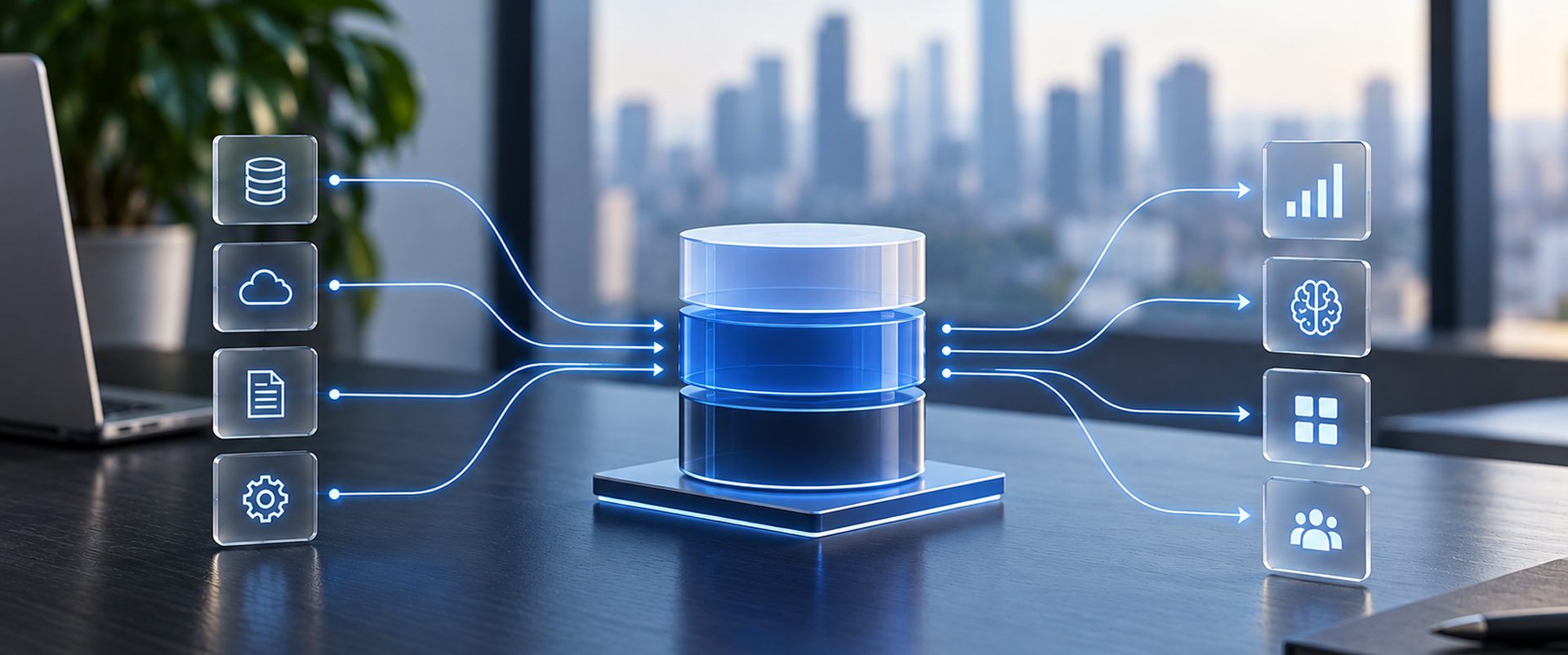
When business teams report different numbers for the same metric, decisions slow down and confidence in reporting falls. AI applications using those sources can inherit the same inconsistencies.
Modern data architecture brings together integration, shared business definitions, clear ownership and governance to make enterprise data reliable and accessible. These capabilities help teams trace information to its source, apply consistent rules and control how data is used across analytics, applications and AI.
Building this foundation requires coordinated decisions about technology, processes and accountability. This article presents a practical enterprise data architecture strategy for assessing the existing data environment, prioritizing improvements and delivering trusted data for analytics, predictive AI, generative AI and agentic AI use cases.
Modern data architecture provides a governed, connected foundation that enables business teams, applications and AI systems to access and use reliable, well-defined enterprise data.
Why Legacy Data Environments Hold the Business Back
Legacy data environments can make it difficult to deliver consistent reporting, integrate new sources and support new analytics or AI use cases. As systems and pipelines evolve independently, teams spend more time finding, preparing and reconciling data.
Common challenges include:
- Data silos: Information is spread across systems with limited integration, making it difficult to build a consistent view of the business.
- Inconsistent definitions: Teams calculate or interpret the same metric differently, producing conflicting reports.
- Poor data quality: Missing, inaccurate or outdated data requires manual correction and reduces confidence in results.
- Slow reporting: Fragmented sources and manual preparation delay access to information needed for decisions.
- Duplicated pipelines: Separate teams build overlapping pipelines, increasing maintenance effort and the risk of inconsistent transformation rules.
- Fragmented governance: Ownership, lineage and access controls are inconsistently documented or enforced, making data harder to manage and trace.
These issues increase operating costs and delay decisions. Teams reconcile figures manually, maintain separate spreadsheets and repeat work across projects. Modernization, supported by data architecture services, can reduce this burden by improving integration, standardizing definitions and establishing clear ownership and controls.
A Framework for Modern Data Architecture
Modernizing enterprise data requires coordinated work across business definitions, integration, governance and technology. Start with a priority business use case, assess the relevant data and deliver improvements incrementally. The following framework shows how to build an AI-ready data architecture, with governance applied throughout.
- Assess: Identify the business objective, map relevant sources and pipelines, and establish a baseline for data quality, performance and cost.
- Define: Agree shared business definitions, relationships, ownership and quality expectations for the data supporting the use case.
- Connect: Integrate the required sources and establish access patterns suited to reporting, applications and AI.
- Govern: Establish and enforce access policies, quality rules and lineage requirements, with clear responsibilities for ongoing management.
- Modernize: Retain, improve or replace platforms and pipelines according to business needs, technical constraints and operating costs.
- Activate: Put governed data to work in the intended use case, validate results with users and measure outcomes against the baseline.
These activities overlap and evolve as delivery progresses. Establish definitions, ownership and controls early, then refine them during implementation. Expand to additional use cases as the approach proves effective.
Also Read: What is Data Architecture? Overview and Best Practices
Deciding What to Retain, Integrate, Modernize or Replace
Data modernization begins with understanding which existing capabilities still meet business needs and which require change. Assess warehouses, data lakes, BI tools, pipelines and operational databases against business fit, security, supportability, performance and operating cost.
| Decision | What It Means | Typical Candidates |
| Retain | Continue using an existing capability that meets current requirements, with ongoing maintenance and review. | Supported warehouses and BI tools that deliver reliable performance. |
| Integrate | Connect a useful system through appropriate interfaces, shared definitions and access controls. | SaaS platforms and operational databases needed for reporting, applications or AI. |
| Modernize | Improve an existing capability to meet requirements for reliability, maintainability, performance or cost. | Fragile ETL pipelines, manual workflows and data stores requiring targeted upgrades. |
| Replace | Migrate to a suitable alternative and retire a capability that cannot meet essential requirements at an acceptable cost or risk. | Unsupported databases or platforms with persistent functional, security or scalability limitations. |
These decisions can overlap. A warehouse may be retained while its pipelines are modernized and additional sources are integrated. Apply the decisions at the appropriate level, then plan validation, migration and retirement around business dependencies. This helps focus investment where change delivers the most value while managing disruption and cost.
Reusable Data Across Business Domains
Organizing data around business domains helps connect technical assets to business meaning and accountability. Within each domain, teams can identify datasets, definitions and interfaces that support multiple use cases.
Common examples include:
- Customer and product data: Shared identifiers, attributes and relationships that help teams connect customer, product and transaction records across systems.
- Finance and operational data: Agreed metrics and datasets supporting financial reporting, cost analysis and operational performance.
- Risk and service data: Information supporting risk assessment, controls, service performance and issue resolution.
- Contracts, policies and process documentation: Approved content with clear ownership, version history and access permissions for authorized users and applications.
Priority datasets and content collections can be managed as reusable data products, with named owners, documented definitions, quality expectations and supported access methods. This reduces repeated preparation across projects, supports building a knowledge base for AI agents and gives analytics, applications and AI a more consistent basis for using enterprise data. Where definitions differ by business context, those differences should be explicit and traceable.
Technologies and Patterns Supporting Modern Data Architecture
Modern data architecture combines platform capabilities, integration methods and approaches to ownership and reuse. Select these according to workload requirements, existing investments, security needs and operating costs.
- Cloud data platforms: Provide storage and processing capacity that can scale with demand, with controls to manage usage and cost.
- Data lakes: Store structured, semi-structured and unstructured data for exploration, processing and AI workloads. Cataloging, quality controls and access policies help make that data usable and governable.
- Data warehouses and lakehouses: Support analytical workloads through different storage and processing approaches. A lakehouse combines data-lake storage with table management and analytical capabilities, while supporting unstructured content alongside managed tables.
- Data mesh: Organizes accountability around business domains, with shared standards for publishing and maintaining data products.
- Data fabric: Connects and manages data across distributed environments through integration, metadata and automation.
- APIs and data pipelines: Deliver data through controlled interfaces, scheduled processing or streaming, depending on freshness and performance requirements.
- Semantic layer: Defines shared business metrics and relationships so supported tools and applications can query data consistently.
- Search and retrieval: Use keyword, vector or hybrid search to retrieve relevant enterprise content. These capabilities can support retrieval-augmented generation (RAG) when connected to a generative AI application.
- Reusable data products: Package datasets or content with documented meaning, named owners, quality expectations and supported access methods.
The assessment should determine which capabilities are needed and where existing systems can meet the requirements. When evaluating data architecture solutions, introduce additional components where they address a clear gap, and evaluate their benefits alongside implementation effort and ongoing maintenance.
Case Study: Enterprise Data & AI Modernization | How a Global Media Group Unified Content, Data, and Operations at Scale
Semantic Layers and Ontologies for Shared Business Meaning
A semantic layer translates underlying data structures into business concepts, metrics and relationships. It defines how measures such as revenue, active customers or service performance are calculated and makes those definitions available to supported reporting tools and applications.
Centralizing this logic reduces the need to recreate calculations in individual reports. Teams can use agreed definitions while making reporting periods, filters and other assumptions explicit. Connected catalog and governance capabilities provide supporting information about ownership, lineage and access.
An ontology complements this by explicitly modeling domain concepts, their relationships and relevant constraints. For example, it can describe how customers, contracts, products and service obligations relate across systems. The semantic layer focuses on consistent analytical definitions and queries, while an ontology can support broader interpretation of business entities and their relationships. They can work together, and their scope may overlap depending on the implementation.
AI applications that query through the semantic layer can use approved metrics and relationships rather than infer calculations from raw tables. Where cross-system relationships matter, an ontology can provide additional context. Neither capability guarantees correct responses; data quality, access controls and application evaluation remain essential.
Supporting Predictive Generative and Agentic AI
Different AI use cases place different demands on the data foundation. Modern data architecture for AI should provide the data, context and interfaces required by the intended workflow.
- Predictive AI: Uses historical patterns to estimate outcomes such as demand, churn or equipment failure. It requires suitable historical data, consistent feature definitions and checks that prevent information unavailable at prediction time from entering model development. Monitor model performance and changes in input data after deployment.
- Generative AI: Produces outputs such as answers, summaries and drafts. For enterprise knowledge tasks, it needs relevant context and clear instructions about how approved business information should be used.
- Retrieval-augmented generation (RAG): Retrieves relevant information from enterprise sources and supplies it as context to a generative model when producing a response. A policy assistant, for example, can retrieve approved policy passages before answering an employee question. Reliable implementation requires document preparation, suitable indexing, permission-aware retrieval and testing of evidence relevance and answer accuracy. RAG can improve grounding but does not eliminate incorrect responses.
- Agentic AI: Uses models to select steps and tools in pursuit of a task. An agent might retrieve contract terms, query an approved service metric and propose a follow-up action. It needs controlled data access, well-defined tool interfaces, action permissions and audit records, with human approval where the workflow requires it.
These approaches can be combined. A service agent might use RAG to retrieve contract clauses, a semantic layer to query service performance and an ontology to connect the customer, contract and affected assets. Each capability should address a specific requirement, and an enterprise does not need every component, such as vector databases, for every AI initiative.
Governance and Guardrails
Data governance establishes who is accountable for data, how it may be used and what standards it must meet. Apply consistent policies across the architecture, with controls suited to the sensitivity of the data and the requirements of each workload.
Access controls, privacy measures and retention rules govern how information is handled. Quality checks and operational monitoring help teams detect missing data, delayed updates and pipeline failures. Catalog and lineage capabilities document meaning, ownership and data flows, supporting investigation and change assessment. Usage monitoring and cost thresholds help teams manage platform spending.
In data architecture for RAG applications, enforce source permissions during retrieval and manage sensitive information in prompts, responses and logs. For agentic AI, distinguish permission to read data from permission to take action, and enforce both through the application and tool interfaces.
Establish these controls early and refine them as the architecture evolves. Assign owners to review exceptions, resolve issues and keep policies and documentation current.
Measuring the Outcomes
Measure modernization against the business objectives established at the start. Record the current baseline, agree targets with business and technical owners, and review progress as each use case goes live.
Useful indicators include:
- Reporting reliability: Fewer discrepancies in priority reports and less time spent reconciling figures.
- Time to insight: Reduced time to prepare a report, answer a business question or onboard a required data source.
- Data quality and freshness: Compliance with agreed quality thresholds and update schedules.
- AI performance and readiness: Evaluate predictive accuracy against an agreed baseline, RAG retrieval relevance and answer grounding, and agent task completion and action-policy compliance. Select measures appropriate to the use case and validate permissions and update processes.
- Governance coverage: Priority data assets have documented owners, access policies and lineage.
- Operating efficiency: Reduced pipeline duplication, maintenance effort and cost per workload, accounting for migration and ongoing support.
Select the indicators relevant to the use case and assign an owner to each. Review them alongside user adoption and business results to establish whether the improvements are delivering value.
Common Mistakes to Avoid
Modernization can fall short when platform changes move ahead without clear business requirements, ownership and operating controls. Common mistakes include:
- Treating cloud migration as the complete solution: Moving existing data and pipelines can preserve fragmented definitions and duplicated processing. Assess these issues alongside the migration and prioritize improvements against business needs.
- Building a data lake without clear governance: Unclear ownership, limited documentation and inconsistent quality controls make data difficult to discover and use confidently. Establish these responsibilities and controls as sources are onboarded.
- Introducing AI before validating its data requirements: Conflicting metrics, outdated content or incomplete permissions can undermine results. Define the requirements for the specific AI use case and test data suitability, access and application performance before expanding its use.
Enterprise data architecture best practices include addressing these risks through incremental delivery. Validate each use case with business users, confirm that ownership and support arrangements work in practice, and apply what you learn to the next phase.
How Successive Approaches Modern Data Architecture
Through data architecture consulting, Successive helps enterprises connect data architecture decisions to business priorities, from improving reporting reliability to establishing data foundations for predictive AI, generative AI, RAG and agentic AI. The approach begins with a current state assessment of the existing environment, identifying gaps and determining which capabilities to retain, integrate, modernize or replace.
Shared business definitions, clear ownership, governance and cost considerations guide the work across our enterprise data architecture services. Semantic layers, ontologies and retrieval capabilities are introduced where they address the requirements of the selected use case. Improvements are delivered incrementally, with results validated against agreed requirements before expanding to additional domains and use cases.
Contact Successive to discuss data architecture services, beginning with a data architecture assessment focused on your next analytics or AI initiative. Identify the gaps that matter most and establish priorities for a phased modernization roadmap.
FAQs
What is modern data architecture?
It is a trusted, governed and connected data foundation that gives business teams, applications and AI reliable access to well-defined enterprise data. It is not just cloud migration or a data lake. The point is that data, definitions, relationships and ownership are clear enough to use with confidence.
Why do legacy data environments struggle?
They erode trust through silos, inconsistent definitions, poor data quality, slow reporting, duplicated pipelines and weak governance. The result is that people reconcile numbers by hand and doubt the dashboards. A modern foundation fixes those problems at the root instead of automating them.
What framework is used to modernize data architecture?
A staged sequence: assess the estate, unify siloed sources, define shared business meaning, govern access and quality, modernize the platform and activate trusted data in reporting, applications and AI. The order matters, since modernizing before defining and governing only moves the confusion to a faster platform.
What is a semantic layer and why does it matter?
The semantic layer defines what each metric means, how entities relate, who owns them and what rules apply. It lets two teams pull the same number and get the same answer. Without it, every report re-derives its own logic and AI inherits the ambiguity.
Do we need to replace our data warehouse to modernize?
Usually not. A modernization program sorts the estate into retain, integrate, modernize or replace, so stable systems in active use are kept. Effort goes to the systems that hold the business back, which controls both cost and risk.
How does modern data architecture support AI?
AI is only as reliable as the data beneath it. A governed foundation with shared definitions and quality controls gives models trusted, well-defined inputs. Enabling AI without that foundation means models inherit the same ambiguity the business never resolved.
How is the success of a data modernization program measured?
Through business outcomes set at the start: trusted reporting, faster insights, less reconciliation, AI readiness, better compliance visibility and lower platform cost. The program is judged on decisions and cost rather than on tools deployed.