
Achieving success in the ecommerce domain is no longer simply about money and the size of your warehouse. It’s about choice, and that is all about the variety of products you can make available to the end customer. Today’s retailers are finding that they can offer more choice and ultimately more value to their customers by working together, also coined as collaborative commerce. And a great example of collaborative commerce is an online marketplace.
Just like its brick-and-mortar counterpart, the mall or department store, an online marketplace consists of many shop owners coming together to sell their products through a shared infrastructure. The only difference is that while malls are housed in physical buildings, online marketplaces conduct their business via a digital storefront. Just like malls, the owners of marketplaces aren’t responsible for storing inventory or fulfilling orders. That’s managed by the sellers themselves. Marketplace owners usually charge a percentage on sales completed via the marketplace.
The business model of an online marketplace is a win-win-win for buyers, sellers, and marketplace owners. Buyers benefit from being able to browse and shop across multiple categories of products as well as a variety of brands. Sellers are able to gain access to more buyers than they would independently. And marketplace owners benefit because they’re able to earn a commission on sales without having to bear the inventory and logistics costs.
As an example, consider Nykaa, a cosmetics marketplace set up in India which sells products manufactured in India as well as internationally. Through its partnerships with 1,500 sellers, Nykaa is able to offer a staggering 300,000 products in its portfolio.
Read more about The Seven Secrets of eCommerce Giants
Here’s everything you need to know about launching your own marketplace.
The business case for an online marketplace
First, we’ll explore the reasons why online marketplaces are more advantageous than other ecommerce models, and then we’ll look at how to define the business plan for your marketplace.
Why a marketplace makes sense over a traditional online store
In 2020, $2.67 trillion was spent globally on the top 100 online marketplaces, and marketplace sales comprised 62 percent of all ecommerce sales.
McKinsey’s Super 25 — which accounted for 90 percent of retail market capitalization gains in the wake of the COVID-19 crisis — included several large online marketplaces such as Amazon, Pinduoduo, Home Depot, Target, Wayfair, Etsy and Zalando.
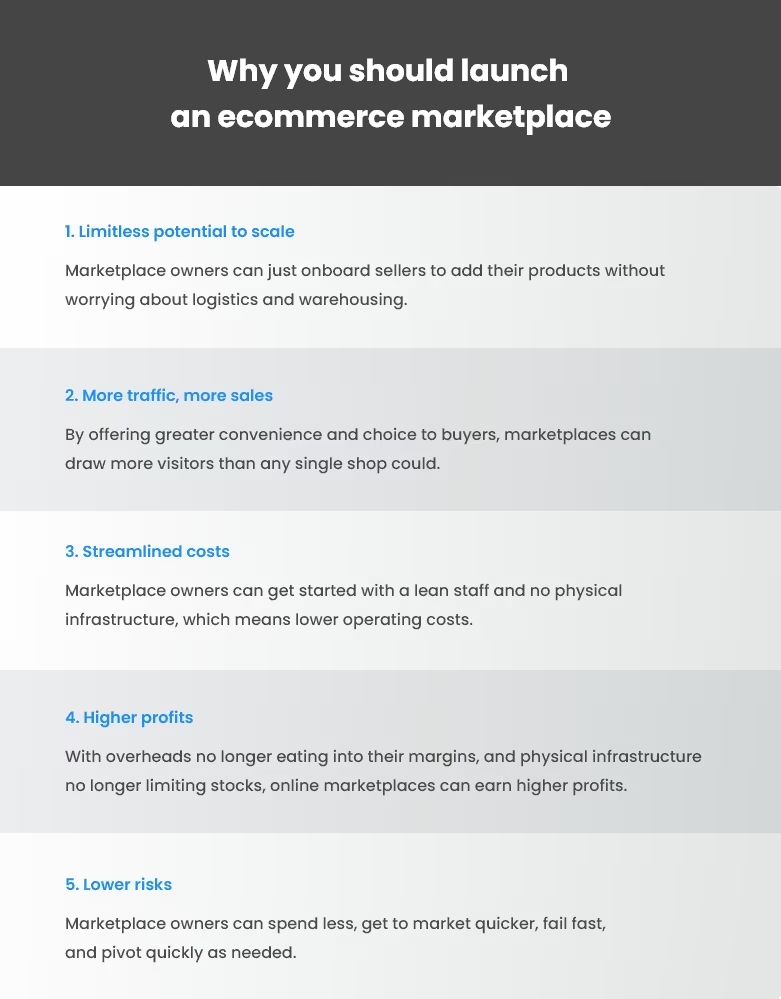
More and more retailers are seeking to leverage the benefits that marketplaces offer, including limitless scalability, higher profits, and reduced risks. Let’s look at some of these:
Limitless potential to scale: Marketplace owners can just onboard sellers to add to their product portfolio. They don’t need to source inventory or worry about warehousing costs. Without holding physical inventory, marketplace owners aren’t faced with the limits of physical infrastructure and resource needs. This translates into a limitless potential to scale.
Potential to attract a large number of buyers: Marketplaces can attract a large customer base because they have the potential to offer a great variety of products.
Customers prefer to buy from specialized marketplaces as they offer greater choice. For instance, a local hardware store may not carry a specific kind of cordless drill that a customer is looking for. But a large online marketplace like Home Depot, which is focused on the home improvement niche and also brings together products from a number of brands, is almost certainly going to have the product they need in stock.
This ability to have all or most of their needs met quickly and conveniently is what attracts more buyers and repeat visitors to an online marketplace.
And once they’re there, the marketplace is likely to be able to recommend more items that they’d find useful — such as drill bits and other accessories. In this way, marketplaces can boost customer engagement, revenue, and the value delivered to customers with each interaction.
Marketplace owners can also quickly respond to market trends by bringing sellers on board who stock particular product lines, taking advantage of seasonal trends.
Streamlined costs: With no logistics and warehousing overheads, the marketplace model comes with a low operating cost. Marketplace operators can create an online marketplace platform with very little staff and infrastructure. This also makes the model more sustainable and environmentally friendly.
Higher profitability: Because of their low overheads, online marketplaces are far more efficient in terms of generating profits.
Brick and mortar marketplaces — such as department stores like Macy’s — have to spend a lot of money on their physical infrastructure, staff, and other overhead costs.
Online marketplaces are more profitable because they eliminate the need for hiring staff, setting up warehouses, and maintaining inventory. Many back-office functions can be eliminated through automation. With these costs no longer eating into their margins, and with physical infrastructure no longer limiting their capacity to sell, online marketplace owners can benefit from far larger profits.

Lower risks: The business model of an online marketplace poses lower risks than most other business models.
Because marketplace owners don’t have to invest a lot in physical infrastructure and resources, the main investment is only in terms of brand design and marketing. The time to market is also significantly reduced, which helps to keep costs low.
When it comes to building the technical infrastructure, creating an online marketplace platform using cloud-based infrastructure offers the opportunity to further optimize costs.
All this helps to lower risk, so that marketplace owners can spend less, get to market quicker, fail fast, and pivot quickly as needed.
Read more about Vertical Marketplaces: The Defining eCommerce Trend
Understanding the business model of your online marketplace
Now, let’s understand how to start an ecommerce marketplace.
Before you begin, it’s important to consider all aspects of your marketplace business. You’ll need to work out what it is you’d like to do, and whether it makes sense to do it.
What is your business idea?
Define your business case. To begin with, you’ll have to define your business case. As an example, you may decide to develop an online marketplace platform that sells handmade goods made by local artisans from a particular neighborhood or community. Or you may decide to create an online marketplace platform for women-owned fashion businesses.
Identify your unique value proposition (UVP). Try and articulate what unique value your business will offer. What problem are you solving? Why does it matter? You can perform a SWOT analysis to understand the strengths and weaknesses of your core proposition.
Focus on a well-defined niche. Instead of aiming for a larger market, the way that Amazon and other large online marketplaces do, try to choose a small niche. Uber, which focuses on ride-hailing services, is a good example of this. Focusing on a specific niche, such as mobile phone accessories or men’s fashion, will help you quickly make a name for your brand and get repeat customers. Once you have a pool of loyal customers, you can safely start to expand into new product categories.
Who is it for?
Identify your target market. Who does your marketplace benefit? Make sure you have a clear picture of the ideal buyers and sellers you want to attract. A persona-building exercise can help with this. Consider aspects such as their familiarity with technology and the effort needed to onboard them.
Understand your market size. Gauging market size is usually difficult to do accurately, especially in the case of a disruptive solution. Prior experience in the industry may help you accurately estimate this. Knowing how large your market is can help you understand the size of the opportunity for your marketplace.

Why is there a need for it?
Understand your users’ key challenges. Acquire a detailed understanding of buyers and their behavior. Where do they spend their time, and what problems do they face along their journey? Similarly, understand your sellers. What challenges do they face with merchandising and selling? What value can you add for them?
Identify competitors and market leaders. Who are your competitors, and what don’t they do well? How will your marketplace be different? Knowing who the leaders are, what they’re doing right and wrong, can help you identify niches where your business can get the edge.
How will you run your business?
Identify your business operating model. Different business models might be appropriate for different businesses and industries.
If you’re running a second-hand car marketplace, then a Peer to Peer (P2P) model might work best — where the buyer connects with the seller, agrees on the price, checks out the car, and buys the car. But in another case, such as if you’re selling art, a dropship model might be the better choice, where the buyer purchases the art from the marketplace which then forwards the order on to the seller who then delivers the order to the buyer.
There may also be instances where a hybrid model is the one that makes the most sense, where some vendors are able to fulfill orders while others offer a pickup-from-store option, and a few orders are fulfilled by the marketplace.
Consider all aspects and identify the model that allows your business to operate efficiently while offering value to the customer.
Choose the best pricing model. Different pricing models might be appropriate for different businesses and industries. Marketplace owners will have to understand the economics of each and pick the one that’s easiest for them to scale.
- Commission-based marketplaces charge a percentage or a flat fee on every completed transaction.
- Subscription-based marketplaces charge a monthly or yearly fee to sellers using the platform.
- Listing fees can be charged every time a seller adds a new listing.
- Freemium models allow sellers to access most features for free, along with a few premium ones for which they are charged a fee.
- Advertising models become more relevant with the increasing size of a marketplace. More users mean increased revenue from ads.
In addition, many marketplaces offer a wide range of value-added services to sellers that create new revenue streams for them, such as training or website development services.
Read more about The Ultimate Go-To-Market Strategy for Your Online Marketplace
Create a roadmap for expansion
Consider the directions you might want to expand in once you’ve got some traction with your initial offering. If you’re selling pet supplies, you may want to begin with selling supplies for dog and cat owners, and over time, begin adding products relevant to owners of more exotic pets. Similarly, if you’re starting out with selling mobile phones and accessories, you may want to expand your business to include other electronics such as tablets and laptops.
Should I build it or buy a ready solution?
Now, it’s time to develop your marketplace platform.
“Multi-sided marketplaces harness the power of network effects to grow exponentially thereby constantly creating value for their users. Without the right technology foundations, however, a network can stagnate and eventually lose its value.”
— Shazad Awan, CEO, Marketcube.io
Custom building your online marketplace platform is the right choice for you if you have a large budget and access to a capable digital agency or ecommerce marketplace developers.
Custom solutions offer a lot of flexibility and total control over the features being developed. But they take a long time to design and develop an online marketplace platform. It could be six to nine months before you’re able to go to market with a functional platform.
Getting to the point where you’ve identified and set up the right mix of functionality can turn out to be a costly proposition. With such a long development time, you may also have to cut corners to get to market on schedule. Additionally, there may be a need to provide training and continued maintenance and support to users, adding to costs.

If custom building your online marketplace is not a practical approach for your business, ecommerce platforms — whether they are free and open-source like WooCommerce, or proprietary like Shopify — allow you to set up an online store very quickly. But these platforms do not allow third-party sellers to add products. Marketplace operators will have to manually list all the products from different vendors on their online store. Additionally, when an order is generated, it will need to be manually shared with sellers using spreadsheets and emails.
This makes running a marketplace using these platforms complex and time-consuming unless you use bolt-on solutions like Marketcube. To allow third-party sellers to list products, marketplace owners will need to set up a third-party system such as Marketcube. Such a solution can push products into the ecommerce platform, take orders, split them up, and send them out to third-party sellers to fulfill and report the fulfillment status back to the buyer.
Since solutions like Marketcube have all the features needed for multi-vendor management, this allows marketplace owners to get to market very quickly and start onboarding vendors from day one. Being in the cloud, such a solution also scales well.
In case you decide to use an open-source platform such as WooCommerce, you will have to host it and run it. This means that as your business grows, you may need some customizations for your features, which you’ll have to manage independently. However, for most marketplace businesses that are selling third-party products, a cloud-based model works extremely well. Because of the short time to market and no requirement for ecommerce marketplace developers, this is also the cheapest option.
Initially, don’t worry about building the perfect online marketplace platform. But do make sure that you validate your product with an initial set of users.
Focus on building a minimum viable product (MVP) with just enough functionality to gather feedback from your beta users. Don’t create any unnecessary features — you won’t be needing all the features on day one. It is cheaper, in the long run, to get out to market quickly, fail fast and change direction quickly than to end up with an unusable product.
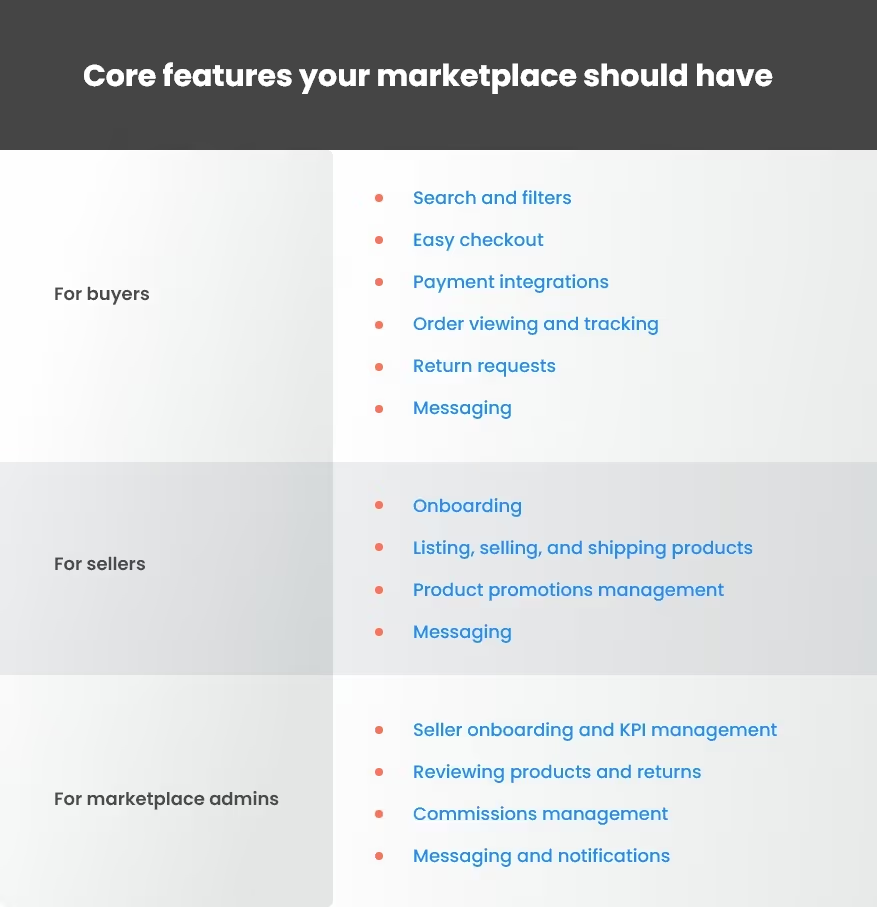
Buyer, sellers, action…
These are some of the key aspects that marketplace operators will need to consider as they begin their operations.
Seller onboarding: While it’s important to nurture both demand and supply simultaneously under the marketplace model, marketplace owners must prioritize bringing sellers on board before buyers. A marketplace that’s not well populated with products that meet buyers’ needs is not likely to become popular. Getting sellers to sign up and list their products has to be the first step.
Order processing: When an order comes in, marketplace operators should be able to split the order and send it to each seller that is part of the order. The seller can then process the order and fulfill it.
Payouts: Since the marketplace is responsible for the transaction, once the order is fulfilled, marketplace operators need a way to make payments to the third-party sellers. Payments can be done manually or using online payment processing software such as Stripe or PayPal. Marketplace owners will need to consider how to manage these payouts.
Returns: If an order goes wrong, marketplace owners should have a way to manage returns. Even though the inventory isn’t held by the marketplace, your marketplace will need clear return policies for third-party sellers.
Customer service: Marketplace operators also need to consider how they will offer customer service while maintaining operational efficiency.
In conclusion
Successful marketplaces grow by increasing their product assortment over time, building visibility for sellers, and making the seller management process seamless. As your marketplace’s reputation grows, you’ll attract more sellers. And the more sellers and products you have, the more returning customers you can expect.
The best and safest way for a marketplace to grow is if people enjoy the experience of using the marketplace. By focusing on making your buyers’ and sellers’ experience simple and pleasurable, you can trigger network effects that keep your marketplace growing for a long, long time.
If you’d like to get started with a solution that can help you rapidly set up a branded online marketplace, check out Marketcube — the leading multi-seller marketplace management platform on the market today.