.avif)


.jpg)
In today's digital world, a cloud strategy has become a key factor in organizational success. This is the reason why companies are increasingly looking at hybrid cloud and multicloud as an important enabler of innovation, operational agility, and revenue scalability.
The real challenge is whether to go for a hybrid cloud or a multicloud?
A cloud strategy must be well aligned with the digital transformation strategy, placing technology as a major driver of competitive advantage and as a means for extraordinary customer experience transformation. Therefore, businesses need to assess the advantages, risks, and operational models of multi-cloud vs. hybrid cloud thoroughly to be able to ensure their way towards digital leadership.
Defining the Two Paths: What is Hybrid Cloud & What is Multicloud?
Hybrid Cloud
A hybrid cloud connects the on-premise or private cloud systems with the public cloud environment for workload flexibility and governance. Hybrid cloud computing enables compliant modernization in some of the most regulated industries, such as healthcare, BFSI, and government, where strict control of data is required to be maintained. Many enterprises deploy hybrid cloud computing when, for security reasons or legacy dependencies, mission-critical workloads cannot move completely into the public cloud.
Multicloud
Multicloud refers to the distribution of workloads and services across a number of public cloud providers: AWS, Google Cloud, Azure, among others. The model is free from the risk of being dependent on a particular vendor. Properly designed multicloud usage guarantees the company to be more resistant to failures, to be able to optimize its performance worldwide, and to have the flexibility of the prices due to the competition in the cloud markets.
Multi Cloud vs Hybrid Cloud: A Strategic Leadership Comparison
Though often misunderstood as similar, these models diverge meaningfully in business outcomes, governance, and growth opportunities.
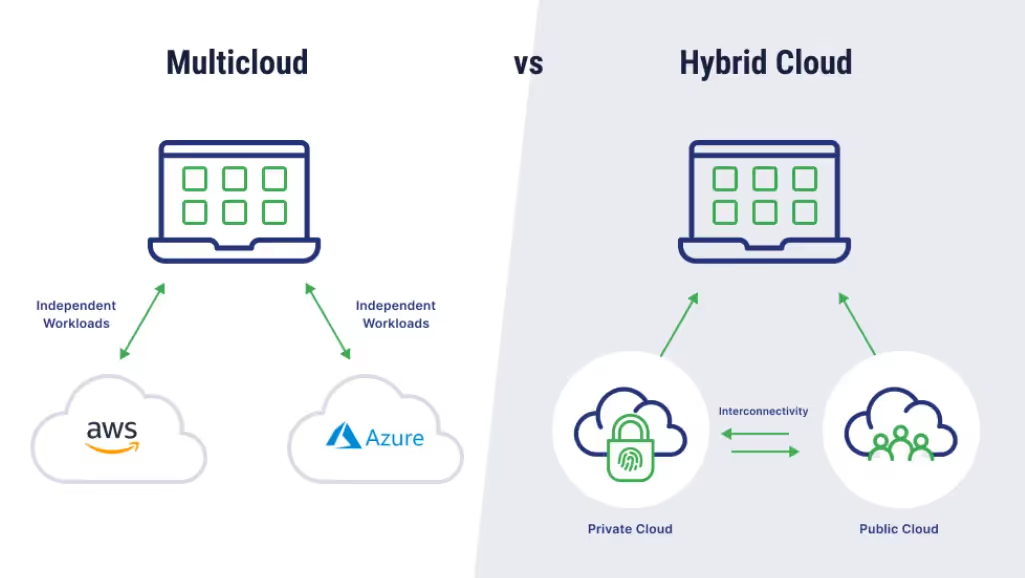
- Architecture- The Core Design Difference
Hybrid cloud architecture combines public and private environments into a centralized and policy-consistent technology framework. Investing in hybrid cloud architecture ensures data authority, infrastructure reliability, and strengthens modernization with low disruption. Leaders adopt a hybrid cloud architecture when they want innovation without abandoning foundational systems.
A multicloud architecture focuses on provider diversification, empowering organizations to access the best services available in each cloud category. Multicloud promotes rapid expansion and innovation without physical infrastructure management.
- Workload Distribution and Interoperability
Hybrid environments allow workloads to move between public cloud and on-premises based on usage and regulatory conditions. This flexibility is beneficial to legacy systems and critical transactional workloads.
In multicloud, workloads are spread across different hyperscalers, requiring advanced orchestration and integration capabilities. Smart workload placement boosts performance in complex digital ecosystems.
Also read: How is Digital Transformation Shaping Customer Experience
- Vendor Lock-in and Risk Management
Business leaders choose multicloud to safeguard against platform dependency. Switching providers or rebalancing workloads is easier when no single vendor is dominant.
Meanwhile, hybrid cloud computing can be heavily dependent on one specific public cloud provider and internal infrastructure, thus generating a different kind of risk that needs to be lessened by making wise architecture choices.
- Pricing and Cost Efficiency
Multiple cloud vendors allow an organization to choose the most affordable pricing structure per workload type. The cost of high-consumption analytic workloads may be much more affordable on one cloud compared to another.
Hybrid cost models require both internal infrastructure ownership and public cloud billing, further reinforcing the need for cost governance in cloud computing.
- Availability and Business Continuity
With a distributed multicloud setup, if a service goes down, workloads can be pushed to alternate regions or providers, reducing downtime exposure.
Hybrid environments rely on both the reliability of internal systems and the selected public cloud, which can create two dependent failure points.
Data Handling and Control- A Critical Regulatory Factor
Data Storage Structures
Hybrid cloud solutions bring together private and public storage: sensitive or regulated data can stay on-premises while scaling public cloud for broader operational needs. Hybrid cloud solutions simplify compliance reporting and cyber defense against advanced threats.
If compared, multicloud storage makes scaling and cross-market deployments easier, especially for global enterprises. Still, multicloud requires increased governance to prevent data redundancy or fragmentation.
As regulatory mandates mature globally, many leaders first adopt hybrid cloud solutions before expanding into multicloud architectures.
Security- Shared Accountability with Customizable Defense
Hybrid cloud technology provides higher customization of security controls, identity management, and governance across all environments. Industries that require deep security configuration rely on hybrid cloud technology to enforce compliance tightly and protect IP.
While multicloud must align to standardized public cloud security frameworks, hyperscalers still maintain advanced global compliance. Cloud Consulting experts support organizations in assessing risk and ensuring both models reinforce a resilient cybersecurity posture.
To stay ahead of threats, business leaders increasingly invest in hybrid cloud technology as the backbone of a secure business growth model.
The Similarities: Why Both Models Dominate Modern Cloud Adoption
Despite the structural and operational differences, multicloud vs hybrid cloud decisions share certain enterprise objectives:
- Shared Security Governance
Both models operate under shared responsibility frameworks. IAM, encryption, and data governance remain customer responsibilities even when infrastructure security is cloud-owned.
- Data Management Complexity
Hybrid needs solid integration tools for private-to-public data flow, while multicloud requires platform-to-platform consistency and API alignment. Cloud Consulting helps automate these aspects.
- Compliance and Certification
Hybrid allows greater control over jurisdictional placement; multicloud leverages built-in compliance of hyperscalers like HIPAA, GDPR, and PCI-DSS.
- System Complexity Rising
Both models introduce new operational integration demands that IT must continuously refine.
Can Hybrid Cloud Be Multicloud?
Yes, many hybrid cloud technology implementations incorporate multicloud elements. However, the reverse is not always true. A multicloud deployment does not automatically include private or on-prem components.
This distinction is important for compliance, architecture modernization, and resource planning.
Why Companies Choose Multicloud
Organizations embrace multicloud when:
- Innovation and speed are business priorities
- Avoiding provider lock-in is essential
- Performance varies by cloud services
- Business scale spans geographies
This fuels Customer experience transformation through faster load times, expanded digital services, and market-specific tailoring.
Why Companies Choose Hybrid Cloud
Leaders select hybrid cloud computing when:
- Certain workloads must stay in a controlled infrastructure
- Data sovereignty and privacy take priority
- Legacy apps require staged modernization
- Seamless business continuity is essential
A well-orchestrated hybrid cloud computing framework creates a secure path to modernization for organizations with traditional IT estates.
How to Choose the Right Strategy: Leadership Decision Factors
Business executives should evaluate:
- Workload performance and compliance
- Operational agility and growth potential
- Cost models and optimization opportunities
- Risk balance- cyber, vendor, and regulatory
A unified digital transformation strategy must guide these decisions and ensure that cloud capabilities ultimately strengthen:
- Broader innovation portfolio
- Service delivery excellence
- Revenue scaling across markets
Cloud consulting will thus play a transformative role in aligning architecture, operations, and governance to business objectives and future vision.
Cloud Strategy is Business Strategy
Modern enterprises are rewriting their transformation playbooks through hybrid cloud and multicloud models. There is no single winner.
A strong cloud strategy, supported by hybrid cloud solutions, hybrid cloud technology foundations, intelligent use of multicloud, and a visionary digital transformation strategy, empowers businesses to excel in this competitive environment while advancing Customer experience transformation.
Leading with the cloud means leading with courage- the courage to modernize, adapt, innovate, and disrupt.
At Successive Digital, we accelerate modernization using automation-driven frameworks that reduce risk and maximize value. We provide world-class Cloud Consulting that helps in harnessing hybrid cloud solutions, adopting hybrid cloud technology, and unlocking full innovation potential through multi-cloud deployments.
Connect with Successive Digital today and shape a future where cloud innovation drives measurable business success.