.avif)


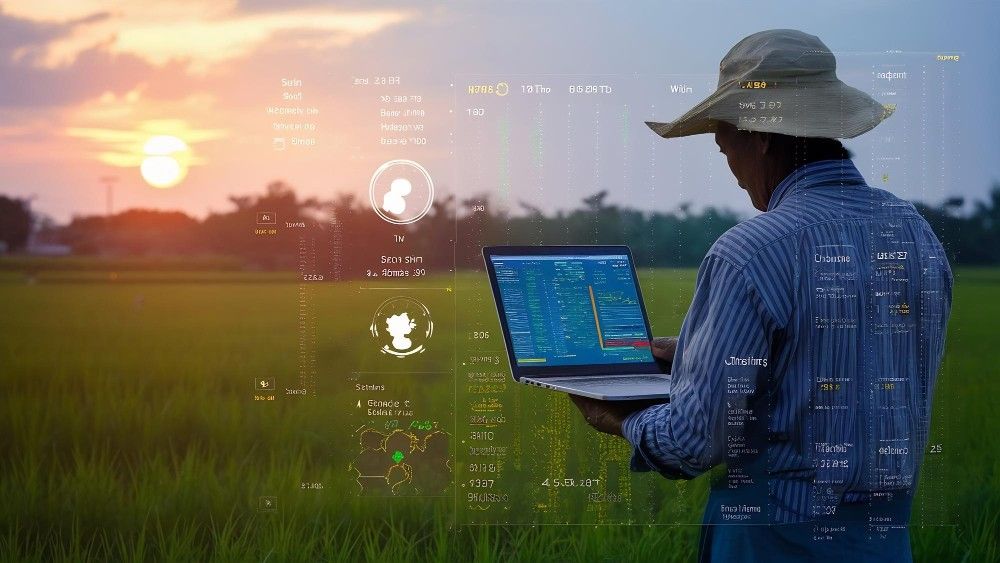
Water is rapidly becoming the most critical constraint in agriculture, as well as a systemic threat to food security and global markets. According to Forbes, water deficiency is becoming a significant threat to global markets worth $300 billion, and an astonishing amount of $58 trillion of GDP is at risk due to poor water availability in various regions, including food production. In the Agritech ecosystem, it is no longer an environmental issue, but an economic and operational risk that is realigning how agriculture is planned, governed, and scaled.
The figures are even more disheartening when it comes to human beings: they are estimating that by the year 2026, up to 3.5 billion humans may be living in water-strained conditions. Agriculture, as the primary consumer of freshwater (approximately 70 percent of all freshwater removals worldwide), will be the most impacted in this scenario. This is pressuring businesses to reconsider water governance as part of a wider digital transformation strategy, in which data-driven allocation is substituting intuition and historic averages.
The situation is getting worse with climate change, where there is a higher variability in droughts and floods. Moreover, agricultural products that are cultivated in the regions where water is stressed have now become one-quarter of the global crops. Therefore, water saving has become an inevitable fact.
In such circumstances of great risk, GIS data can no longer be regarded as a luxury of technique. Instead, it is the strategic pillar that allows agri-leaders to allocate water more efficiently, and do this in a resilient and equitable way.
Also read: How Digital Transformation is Growing the Agritech Sector: Sowing Seeds of Innovation
From the Static Surveys to Dynamic Water Resource Spatial Intelligence
For decades, water resource planning was tethered to siloed datasets, periodic survey data, spreadsheets of groundwater levels, and ad hoc rainfall records. These fractured views made it nearly impossible to understand hydrological dynamics at scale. Today’s GIS software has flipped this paradigm.
Critical Capabilities that Lead to Modern Water Allocation
- Combination of Multisource Data: GIS systems intersect satellite, ground sensor, past hydrology, and climate forecasting information all into a single spatial structure. This allows water managers to co-locate surface water availability to soil moisture, crop water demand, land use, and regulatory boundaries in a single analytic environment.
- Spatial Context & Thematic Modeling: The process of watershed runoff, evapotranspiration, and recharge rates is now considered as a spatial layer and dynamic model rather than a static number, thereby enabling spatially explicit decision support.
- Temporal Analytics: GIS software makes it possible to examine water information across time spans, from hourly sensor measurements to decadal weather patterns, which is quite essential in predicting demand and supply, and aligning with a digital transformation strategy.
In practice, this means that allocation decisions are made on the basis of the continuously updated spatial intelligence, which represents the variability of supply, demand, and risk rather than the periodic snapshots. For large-scale Agritech, this transformation will allow the planners to react to the change instead of just reacting to the losses.
Enhancing Water Resource Assignments With Granular, Layered Intelligence
In irrigation-intensive and groundwater-intensive agriculture regions, such as the irrigation districts and groundwater basins, GIS software not only enables easier mapping but also offers contextualized allocation strategies.
Essential Allocation Enhancements of GIS:
- Watershed and Basin Characterization
GIS can delineate watershed units and sub-watersheds, model drainage networks, and classify zones according to hydrological properties. Such detailed mapping is important in the process of allocating water rights. Recharge areas should be prioritized first, and competing demands in agriculture, urban interests, and ecosystem services should be managed.
- Demand Estimations and Irrigation Planning.
With the GIS, precision irrigation planning could be achieved through combining the data of the soil types, land use, crop coefficients, and past weather into spatial models. GIS software can optimize site selection, and an irrigation network can be designed based on the actual demands rather than the heuristic estimates.
- Drought risk assessment
GIS facilitates the forecasting of floods and droughts using elevation models, stream networks, and the patterns of the land cover. This way, seasonal overflow and chronic water shortages are identified. As an example, buffer analysis can be used to define those areas that are likely to become flooded, and as such, allocation protection is required, as opposed to drought risk regions that can be established as a location where water banking or conservation programs can be adopted.
Real-Time Intelligence/ Decision Support
Static maps are no longer sufficient but rather real-time or near-real-time decision support because the water conditions can shift rapidly due to weather, infrastructure failures, or regulatory changes.
Technology Trends Making Real-Time Allocation:
- IoT & Sensor Integration: Data is constantly being processed into the GIS platforms by soil moisture sensors, smart meters, and automated weather stations. These inputs can be recalculated to water balances in the field and at the basin level, which is the foundation of digital engineering architectures today.
- Remote Sensing Time Series: Satellite data (e.g., Landsat, Sentinel) provides continuous monitoring of surface water bodies, crop stress, and vegetative responses to water availability. These indicators are vital for changing allocation as conditions evolve.
- Cloud & API-First Platforms: Today, GIS platforms have APIs that can be used to interchange data across systems, indicating that water allocation choices can be made utilizing operational systems (e.g., irrigation controllers, water markets) without manual transfers, enhancing timeliness and precision within a unified Digital Transformation Strategy.
These developments make water allocation a synchronized process that can be updated and optimized dynamically and in a flexible manner.
Also read: Elevating Customer Experience for a Leading Agritech Business
Predictive Modeling: Zeroing In on Future Water Demand & Supply
Predictive analytics is at the intersection of GIS value generation of water allocation. Although historical data is useful in comprehending the situation of the past, predictive models (usually driven by machine learning) are useful in predicting changes.
Key Predictive Use Cases
- Drought & Flood Forecasting
The newest GIS processes combine remote sensing indices (such as NDVI or soil moisture proxies) with climate models to predict water availability and extremes. These projections are imperative towards proactive allocation adjustments and minimizing crisis management through reaction.
- Water Demand Estimation
The machine learning models that deal with years of crop yield, weather, or water use patterns can predict the demand for water within a season or a year with fair precision. Connecting these predictions to spatial water allocation systems, farmers and planners can modify schedules and policies.
Data Architecture & Standards: The Belief of Trustworthy Allocation Models.
Effective allocation decision-making demands not only excellent GIS models but also effective data infrastructures. This is where it becomes technical, but it is also where the payoff of GIS investments shines.
Core Data Requirements:
- Interoperability: Water systems are beyond the scope of a single jurisdiction and technical domains. Open standards guarantee that sensor data, satellite images, and administrative datasets can work together without any problem, which is a vital condition for enterprise-grade Digital Engineering.
- Temporal Resolution: The data of high frequency (e.g., hourly sensor feeds) should be integrated with the data of lower frequency (satellite data and static land cover maps) - it necessitates a careful temporal scaling and harmonization.
- Metadata & Provenance: Decisions made by a regulated water system should be auditable. Metadata protocols and lineage, quality, and timestamping of data are necessary.
The engineering excellence of data architecture is not only enjoyed by engineers; it is the basis of reliable allocation models, which can withstand challenge, legal actions, and evaluation of policy.
Strategy Implementation Issues and Strategy in Water Resource Transformation
Despite the transformative potential, there exist actual challenges:
- Data Availability and Quality: In most areas, particularly in the developing economies, surface and groundwater information can be either incomplete or inconsistent. Interpolations and extrapolations are possible with the assistance of GIS, yet the investments in data are essential for a successful digital transformation strategy.
- Human Capacity and Change Management: Water agencies and farm advisory services must build competencies in geospatial analytics, a cultural as well as technical shift.
- Enterprise with Legacy Systems: Many irrigation districts and utilities use legacy SCADA or ERP systems. The integration of GIS software may need middleware or the redesign of processes.
The solution to these is good leadership, gradual execution, and the business case, which should be well established in terms of operational effectiveness as well as risk reduction and resilience.
Conclusion: GIS as the Strategic Backbone to Water Allocation.
The process of water allocation in the agricultural sector has exceeded the single-period planning and surveys. What’s needed is a spatial intelligence infrastructure that would integrate real-time tracking, predictive analytics, stakeholder cooperation, and governance criteria into a single system.
For basin managers, farm technologists, and agritech solution providers, it is a strategic necessity of water security, agricultural sustainability, and economic resilience. With the challenges mounting on water systems, any organization that incorporates GIS in its business and planning processes, supported by scalable digital engineering practice, would have a clear upper hand in distributing water resources in an effective, fair, and sustainable manner.











.jpg)