Generative AI represents a significant advancement in the field of technology, moving beyond traditional machine learning models to create relevant content.
The customer adoption of Gen AI technology across industries has been much faster than any previous technology. The models generate human-like text, images, audio, and code based on the patterns and insights they’ve learned from vast datasets. This generative potential creates unlimited opportunities for organizations trying to improve their customer experience. This blog will uncover the vast potential of generative AI in CX and how it helps organizations to develop more retaining relationships with their customer base through the convergence of AI and customer experience. We’ll also provide a technical overview of Gen AI and its applications across functions.
The Role of Customer Experience for Businesses Today
Relevancy is the key differentiator for brands to keep pace with today’s customers.
By strengthening relationships, organizations can infuse customer experience as a natural expression that generates the highest economic value. Generative AI helps businesses gain that relevancy by anticipating their customers’ needs and rapidly responding to them with meaningful hyper-personalized experiences.
Generative AI: Disrupting Traditional CX Paradigms
Generative AI models disrupt the traditional CX approaches in many ways. Traditional CX was reactive, addressing customer issues after they arose rather than proactively anticipating and addressing customer needs.
The shift from Product/Service-Centric to Customer-Centric
Traditionally, businesses focused on what they wanted to sell, cultivating a product-centric approach. The traditional CX shifts this mindset to a more customer-centric model where the focus is on understanding customer needs and preferences. This transition is encapsulated in the phrase, “What products do you want?” rather than “Who wants my products?”.
Data-Driven Insights
Data has been playing the continuous CX Paradigm. Customer-focused companies are utlizing customer data to identify pain points and opportunities for improvement by gathering and analyzing data from various channels to create a seamless and relevant customer experience.
Gartner reveals that by 2025, 80% of organizations will be applying generative AI technology in some form to improve employee productivity and customer experience.
Generative AI for customer experience helps organizations embrace a shift by adopting a proactive mindset that solves customers’ challenges even before they know it.
While most discussions about generative AI for customer experience revolve around its use in conversational bots, this blog will holistically measure its impact at the enterprise level.
Many unknown impacts of Gen AI need to be unfolded with its increasing adaptability across industries. However, we know that through the power of Generative AI, organizations can enhance their relationships with their customers through greater personalization.
AI customer experience is a game-changer, fundamentally transforming how our customers consume information, solve problems, and generate ideas. Its potential is vast, opening up a world of exciting possibilities. How can customer-centric organizations make the most of Gen AI to improve customer experience? We’ll have to go into the basics to understand this better.
What is Gen AI?
Generative AI is a type of artificial intelligence technology that can produce various types of data augmentation in the form of content, including text, imagery, audio, and synthetic data.
Gen AI models are trained on large datasets of existing content, which allows them to learn the underlying patterns and relationships in the data and create bigger, smaller, fairer data augmentation or richer synthetic data versions of the original data.
These models utilize natural language processing (NLP) techniques to comprehend and interpret human language, enabling them to respond accurately to queries, summarize information, and translate languages. This understanding allows LLMs to engage in meaningful conversations, making them suitable for applications such as chatbots and virtual assistants.
With every interaction with customers, the model learns to generate new content that resembles the patterns in the previous conversations. When any organization employs a Gen AI model as part of its customer experience strategy, the model’s continuous learning helps the organization provide relevant solutions/services/responses to the customers.
Gen AI in Customer Experience: Architecture Explained
A neural network architecture in generative AI is known as the structure and components used to build and deploy generative AI models. Here are the key components and layers involved:
- The Input Layer receives the raw data, which is further processed by the following layers to generate responses.
- Hidden Layers perform the bulk of the computations, extracting features and patterns from the input data.
- Output Layer generates the desired output, whether it’s a classification or prediction or, in the case of generative AI, a newly created piece of content.
Archtecture of Gen AI
A Generative AI model being implemented within the customer experience strategy is typically built and trained on these architectural approaches:
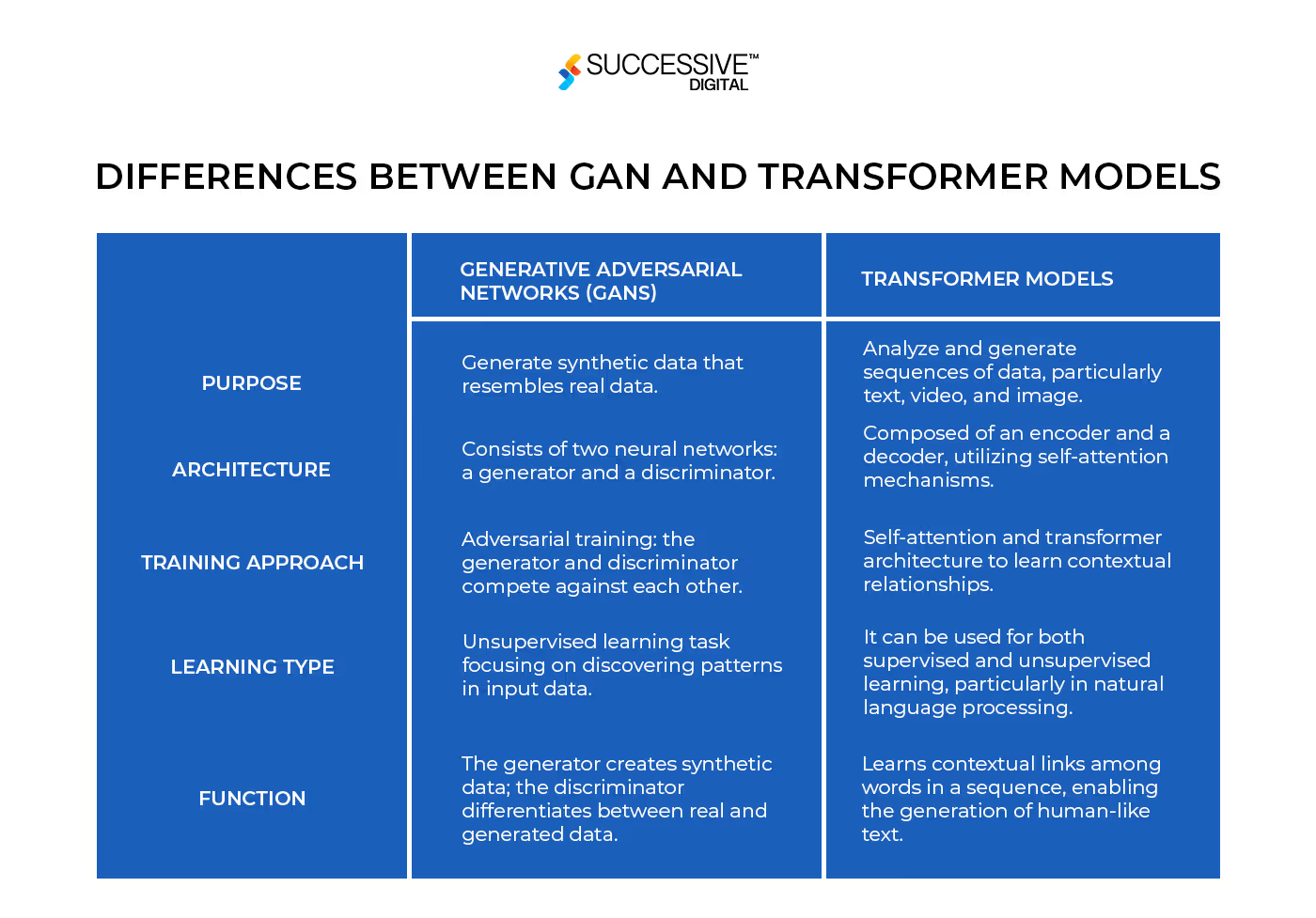
Generative Adversarial Networks (GANs):
GANs are a way to train a generative AI model by framing the problem as a supervised learning problem with two sub-models.
GANs use two neural networks – a generator and a discriminator – that compete against each other.
Generative modeling is an unsupervised learning task in machine learning in which regularities or patterns in input data are automatically discovered and learned so that the model can be used to generate or output new examples that could have been drawn from the original dataset.
Within the architecture, the generator generates realistic-looking synthetic data, and the discriminator separates the generated data from real data. This adversarial training procedure improves the generator’s ability to produce more convincing outputs.
For example- In the case of images, for example, the “generator” makes the image while the “discriminator” determines if it is real or generated.
Transformer Models:
Transformer is an architecture of neural networks that takes a text sequence as input and produces another text sequence as output—for example,
Translation from English (“Hello”) to French (“Bonjour”). Many popular language models are trained using this architectural approach.
Transformer models are able to capture context by comprehending the way words interact within a sentence. Transformers process every sequence component concurrently, as opposed to traditional models that handle things. This makes Transformers effective and GPU-friendly.
The Transformer architecture has also been used as the foundation for numerous projects, including Google’s BERT and OpenAI’s GPT-3 and GPT-4, two of the most potent generative AI models. These models can be used to produce prose that appears human, assist with coding assignments, translate across languages, and provide answers to queries on practically any subject.
Generative AI Training Processes
Generative AI models are trained using various continuous machine-learning techniques. Hence, they can upgrade themselves with every interaction. Here are the three machine-learning techniques that these models are trained on:
- Supervised learning lets the model train on the labeled training data, where the input and the desired output are already provided, known as Naive Bayes algorithms. Based on the existing data, the model learns how to map the input and output to generate new, similar outputs.
- The unsupervised learning method trains the model on unlabeled, alien data to identify patterns and structures, allowing the model to generate new data that resembles the original data without being told what the output should look like. The unsupervised learning model works on K-mean algorithm where the homogeneous characteristics data is clustered together to form output.
- Reinforcement learning trains the model to interact with an environment and receive feedback (rewards or penalties) based on its actions, allowing it to generate outputs that maximize the desired outcome.
Model Training Process
Here is the training process of a generative AI model
- The first step is data collection and processing by cleaning, formatting, and structuring it for effective model training.
- After this, a model architecture, such as GPT, DALL-E, or Stable Diffusion, is selected.
- The unsupervised pretraining is done on the preprocessed dataset to enable the model to learn general language patterns and semantics.
- After the pretraining, the model is trained through the supervised ML to specialize the model for the target task.
- To improve the model’s performance, it is optimized with hyperparameter tuning and regularization techniques.
Dataset Requirements
Effective training of generative AI models requires high-quality datasets that meet specific requirements, such as:
- The dataset shall be volume in volume to capture the diversity and complexity of the target domain. Such as, while creating an AI avatar, the dataset shall contain a diversity of features, moods, expressions, body movement and gestures, audio data, 3d model data, and customization preferences
- The dataset shall be accurate, complete, clean, consistent, and valid for its intended use case.
- The dataset shall include a wide range of examples to ensure the model can generalize well.
- For supervised learning, the dataset shall be labeled, while for unsupervised learning, it shall not require labels.
Generative AI for Customer Experience
The Gen AI for customer experience is increasingly being used to deliver human-like, emotionally engaging, empathetic, and personalized customer and employee experiences that represent the organization’s values.
Through the productivity and efficiency gains that generative AI brings, the impact of Generative AI on customer experience is multifold:
- Generative AI for customer experience unfolds the potential to transform business processes and make them personalized and faster.
- Gen AI allows customers to self-assist with the help of conversational AI and customer self-service options,
- Gen AI enables business functions to focus on more strategic work instead of repetitive and time-consuming tasks.
Advanced Applications of Generative AI in Customer Experience
1. Personalized Customer Interactions
76% of consumers today expect brands to understand their needs and expectations. At the same time, 84% of customers say they want to be seen and treated as a person, not a mere statistic. Customers are likely to avoid brands that do not provide a customized personal experience, and Gen AI models do exactly the same— personalize the customer experience with every interaction.
According to a 2020 survey, 70% of organizations that use sophisticated customization have already received a 200% or higher ROI.
Gen AI models utilize advanced recommendation algorithms that analyze the huge amounts of customer data collected from various sources, such as:
- browsing history
- purchase patterns
- explicit preferences
- CRMs
By training large language models like GPT-4 on this customer data, organizations can uncover deep insights and make highly personalized product and content recommendations.
However, GenAI’s personalization capabilities continue beyond that.
Real-time interface customization, powered by predictive analytics and user behavior modeling, allows customer-centric businesses to dynamically adapt the user experience for each customer, optimizing product placements, content, and overall interactions to maximize relevance and satisfaction.
2. Customer Support Automation
Most brands utilize tools like chat to handle customer assistance and direct them to the optimal next step in the conversion process. However, while a standard chat function only answers basic questions, the GenAI chatbot does more, increasing customer lifetime value. GenAI-powered chats use real-time consumer data, learn from past encounters, and engage in contextual conversations, unlike traditional chat that relies on static scripts. This enables businesses to automate customer assistance while maintaining rich connections across journey stages, resulting in consistent, high-touch experiences.
Also read- The rise of Chatbots and Virtual Assistants to learn more about AI-powered conversations and the evolution of gen AI-powered chatbots.
The data gained from these interactions can also produce significant value, surfacing insights that can be funneled back into the customer experience strategy to derive meaningful insights for the CXaaS functions.
Customer experience AI responds intelligently to user requests using modern technologies such as natural language processing and analytics. When users interact with the chatbot, the NLP model analyzes the input to identify keywords, phrases, and overall meaning. These bots are trained on several criteria that allow them to provide text-based answers; these parameters include—
- User intent
- Promote context
- Prompt sentiment
- Contextual answers to the cues
Let’s see how AI-powered chatbots work.

How an AI chatbot works
- The systems use natural language processing (NLP) to evaluate the text and determine the user’s query (intent).
- After the intents are recognized, the relevant action is carried out via the underlying API connections within the Dialog Management module and returned to the user as an answer.
- Once an assistant has prepared a response, it is sent to the output module. The module examines the received material, creates a narrative framework, combines words and sentence pieces, and adheres to grammatical standards.
Other than this, Transformer models like BERT and GPT-3 can be highly effective in enhancing customer support experiences.
Intent Classification with BERT: Google’s BERT (Bidirectional Encoder Representations from Transformers) allows the system to route the customer to the appropriate support channel or provide a relevant initial response. Since BERT reads the data bidirectionally, intent classification is simplified.
Response Generation with GPT: Gen AI models like GPT-3 and 4 (Generative Pre-trained Transformer 3) can produce coherent, empathetic, and informative responses to address customer needs.
Technical Challenges
Gen AI-driven customer support models allow organizations to deliver automated, personalized, and efficient customer experiences. However, it presents some challenges, such as:
Ensuring Human-like Interaction:
Training generative AI models to produce human-like responses can be challenging. To enhance the conversational experience, techniques like persona modeling, emotional intelligence, and natural language generation should be incorporated.
Context Maintenance:
It’s important to ensure that generative AI models maintain context and coherence across multiple turns of the conversation, providing a seamless and natural interaction.
Handling Ambiguous Queries:
Since the customer is now having a conversation with these models, it’s important to develop robust intent classification and response generation models that can handle ambiguous, open-ended, or complex customer queries. For this, advanced natural language understanding techniques and knowledge bases should be utilized to infer the customer’s intent and provide appropriate responses.
3. Enhanced Customer Insights
The richness of data available allows companies to customize customer experiences at an unprecedented level of detail.
Predictions Using Nuerals
Predictive analytics is a domain where generative AI is making a significant impact. Since Gen AI models can analyze and understand large volumes of data, they can very well predict future customer behavior.
Generative Adversarial Networks (GANs) incorporate a discriminator network that learns to distinguish real data from generated data. This discriminator network can then be used to make predictions about new data.
As a type of recurrent neural network, LSTM, Long-short-term memory networks predict customer churn and estimate customer lifetime value based on historical data by learning complex, non-linear relationships between various customer attributes and their likelihood of churning, going beyond what traditional statistical models can capture.
Dynamic Reporting
Transformer models, such as GPT-3, can be used to generate dynamic, natural language-based reports and dashboards that provide business stakeholders with easily digestible customer insights.
Data Preprocessing for Customer Analysis
These models can help organizations save time by automating the process of identifying and addressing data quality issues, such as missing values, outliers, and inconsistencies, to prepare customer data for analysis. By normalizing the provided data across different scales and units, these models ensure a consistent format for downstream analysis.
Customer Segmentation
With the help of clustering techniques, GenAI models can identify distinct customer segments for more targeted marketing and personalization.
By learning complex, non-linear relationships in customer data, the neural network segments the audience with greater accuracy and granularity.
4. Content Creation for Engagement
Generative AI models are continuously trained to analyze the user’s purchase history, browsing patterns, and behavior.
With the implementation of GenAI, companies can significantly streamline and automate content generation processes. The content generation pipelines begin with collecting relevant data, which is then used to design templates that capture the desired tone, style, and structure. GenAI models, such as Generative Adversarial Networks (GANs), are then fine-tuned on this data to learn the underlying patterns and generate realistic and immersive visual experiences in video games and digital entertainment. In contrast, Transformers are self-supervised to analyze the input embeddings through the encoder while the decoder generates text responses. This analysis helps models improve through continuous learning until they can fully filter individual preferences and customize their recommendations based on specific requirements and choices. As a result, the campaign creation timeline can be drastically reduced to just 1-2 hours, which otherwise would take 1-2 months. Beyond static content, GenAI models also allow dynamic storytelling through sequence-to-sequence models that can generate coherent and contextually relevant narratives.
Metrics To Ensure The Credibility of AI-Generated Content
The quality of content generated by AI systems is assessed through these KPIs.
Perplexity
Perplexity assesses how effectively a probabilistic model (such as a language model) predicts a text sample and is calculated as the test set’s inverse probability normalized by the number of words.
A lower perplexity value suggests that the model performs better at predicting test data, resulting in more cohesive and fluent language.
BLEU Score
BLEU (Bilingual Evaluation Understudy) is a metric used to evaluate the quality of text that has been machine-translated, compared to a reference human translation.
BLEU scores range from 0 to 1, with 1 indicating the generated text is identical to the reference.
Benefits of Generative AI in Customer Experience
Predictive Customer Experience
GenAI can predict customer demands based on previous interactions and data trends, facilitating more active and effective collaboration with the target audience. This predictive skill enables firms to anticipate customer wants and address possible difficulties before they occur. For example, GenAI-powered systems can foresee demand spikes, product preferences, and service requirements, allowing businesses to optimize operations, inventory, and resource allocation to provide seamless, personalized experiences.
Improved Customer Satisfaction and Loyalty
When implemented in a customer experience strategy, Gen AI can significantly enhance customer satisfaction and loyalty through individualized personalization and efficient issue resolution. Gen AI for customer experience extends beyond standard customer service. It generates responses and solutions that are specific to each user’s context. Furthermore, it provides a degree of customization that closely resembles human behavior.
Here are the metrics that can measure the impact on customer experience.
Net Promoter Score: Tracks customer loyalty and likelihood to recommend a company’s products/services.
Customer Satisfaction: Mesures customer satisfaction with a specific interaction or overall experience.
Challenges and Considerations
Hyper-personalization has always been an aspiration for any customer-centric company, and generative AI for customer experience is proving to be the game changer, especially for companies with huge customer bases. Users today expect a level of service that resonates with their individual preferences and behaviors. Without the integration of GenAI, operations involve labor-intensive processes where consumer insights are manually synthesized, feedback rounds are coordinated across multiple teams, and content production requires extensive collaboration between designers, copywriters, and producers. However, GenAI adoption across industries presents some challenges related to scalability and governance.
Data Complexity: Gen AI models create synthetic data; hence, handling the vast amounts of unstructured customer data required for personalization can strain traditional systems, extracting data from multiple data lakes. Hence, utilizing cloud-based infrastructure, such as Amazon S3, is important for advanced and faster data storage and management techniques.
Integration: Seamlessly integrating generative AI into existing customer experience platforms and workflows is critical for a cohesive, scalable solution. Careful system architecture and API-driven approaches are important to ensure seamless integration across compatibility, scalability, and complexity. The existing architecture should also allow the AI systems to expand seamlessly as requirements evolve.
AI Content Biases:
There is a growing concern about the potential for these systems to perpetuate or amplify biases present in their training data.
Biases in AI-generated content can occur in various ways, such as,
- Stereotypical portrayals
- Exclusion of underrepresented groups
- Propagation of harmful prejudices.
The data used to train generative AI models is one of the key reasons for their biases. If the datasets used to train these algorithms are unbalanced or lack diversity, the resulting content may reflect these biases.
Furthermore, the strategies used to train generative AI models may induce biases. The fairness of the generated outputs can be influenced by the objective functions, model topologies, and hyperparameters used.
Future Trends in Generative AI for CX
- Evolution of AI technologies: advancements in neural architecture search (NAS) and automated machine learning (AutoML)
The field of AI has marked some remarkable advancements in recent years, with innovations in neural architecture search (NAS) and automated machine learning (AutoML).
Neural architecture search (NAS) is a technique for automating the design of artificial neural networks (ANN) which has modernized the traditional approach of manually designing the ANN.
AutoML automates processes like data preparation and uses automated processes to identify suitable algorithms.
Now, this convergence of NAS and AutoML will transition for a generative AI-powered future, where AI systems can autonomously generate and refine their own architectures, optimizing for performance, efficiency, and specific application requirements.
- Emerging use cases: real-time sentiment analysis, voice-enabled AI assistants, and augmented reality (AR) applications
As we speak of the advanced future trends of gen AI in customer experience, the technology is hailed as a game changer for sentiment analysis and voice assistants, offering some unique advantages over other methods used for the same purpose.
Sentiment Analysis
Generative AI models can analyze sentiment in real time from customer comments, social media posts, and other unstructured data.
NLP and machine learning are very useful in advertising for opinion mining and evaluating textual data to determine the sentiment expressed therein.
The capacity to quickly process and understand sentiment at scale is a significant advantage of employing generative AI over traditional rule-based or keyword-matching methods.
Voice-Enabled AI Assistants
Generative language models are powering more natural, human-like conversational experiences for virtual assistants by even mimicking the voice. Alexa, which is present in command within households and businesses, is here to stay and is now accompanied by customized voice assistants that interact with users through spoken language.
These AI-driven assistants can engage in free-form dialogue, understand context and intent, and generate coherent, contextual responses.
Augmented Reality (AR) Applications
The advancements in artificial intelligence have allowed augmented reality to become much more accessible to everyday consumers. By integrating Gen AI and AR in an application, customer experience consulting companies can create endless possibilities for organizations, such as
- Generate 3D assets, environments, and animations for AR apps and games
- Dynamically create personalized AR content and overlays based on user data and preferences
- Power AI-driven virtual agents and characters that can interact with users in AR settings
- Long-term vision: the convergence of Generative AI with IoT and edge computing for enhanced CX.
As generative AI continues to evolve, its integration with the Internet of Things (IoT) and edge computing aims to transform the customer experience.
This convergence will help companies deliver more personalized and real-time CX through digital solutions.
One of the key aspects of this convergence is the development of intelligent IoT devices equipped with generative AI models. These devices, ranging from smart speakers to interactive kiosks can enhance customer service as these models can:
- Understand natural language
- Generate human-like responses
- And engage in contextual interactions with customers.
Use Case of Gen AI and IoT
Industrial manufacturing
GenAI can close the data gap that frequently exists in predictive analytics in industrial manufacturing.
When used in conjunction with LLMs such as CoPilot, ChatGPT, BARD, and others, GenAI can combine internet information to improve equipment’s telemetry data by providing suggestions on potential actions and their likely impact, references to additional documents or information that provide additional technical details, success rates of each remediation, and more.
Medical and Healthcare
The healthcare industry uses a lot of Internet of Medical Things devices to collect data. Here, GenAI can simplify the existing datasets, generate representative patient data, and protect actual patient data for privacy compliance. Gen AI can also generate automated medical summary reports of tests and wearables data. Other than this, Gen AI models can perform data augmentation tasks (denoising, reconstruction, registration, etc.) on medical imagery like CTs, MRIs, ultrasounds, and X-rays.
Read more on – Generative AI in Medical Imaging & Diagnosis.
- Research frontiers: exploring unsupervised and self-supervised learning for improved generative models
The research frontiers in generative AI span a wide range of technical and ethical considerations as the field continues to push the boundaries of what is possible with unsupervised and self-supervised learning (learning models are explained in this blog above).
The advantage of these unsupervised and self-supervised approaches is that they can utilize vast amounts of unlabeled data to learn powerful generative models without expensive manual labeling. This enables the models to capture more nuanced and generalizable representations.
As generative AI models become more powerful and widely deployed, there is increasing focus on ensuring their safety, reliability, and robustness.
Researchers are also exploring ways to detect and mitigate biases, toxicity, and undesirable outputs in generative models.
Final Words
Generative AI is the newest tool to emerge and is best understood as part of a progression of customer experience capabilities that organizations need to master.
To make the optimal use of Generative AI for customer experience, organizations need to prepare their prosses to be equally responsive to its vast potential into measurable business value by finding a specific use case, to begin with.
They would need to strengthen their data infrastructure, invest in bedrock AI-driven applications, develop a reliable and secure cloud storage solution, and integrate precision marketing processes.
Successive Digital lays the groundwork through cloud, AI, data, and product engineering capabilities. As a customer experience consulting company, our strategic consultants help businesses identify Generative AI use cases within their existing business processes, eliminate barriers to entry, and ensure the successful integration of GenAI into their business strategy.
Our team also guides businesses through the actions they need to plan, adapt, and implement technology for the seamless adoption of GenAI, from reducing technology costs to adopting the latest best practices in modern organizations.